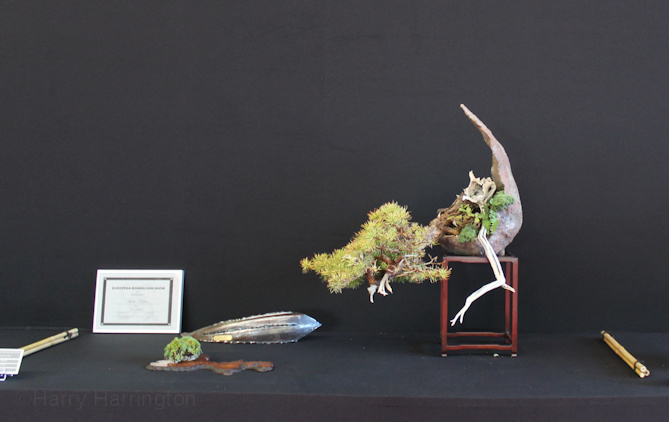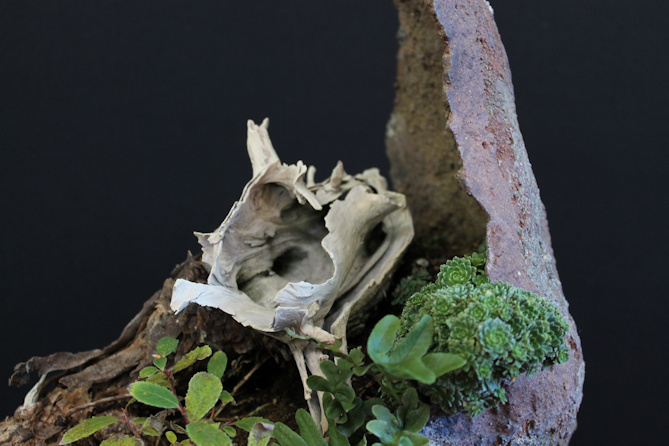
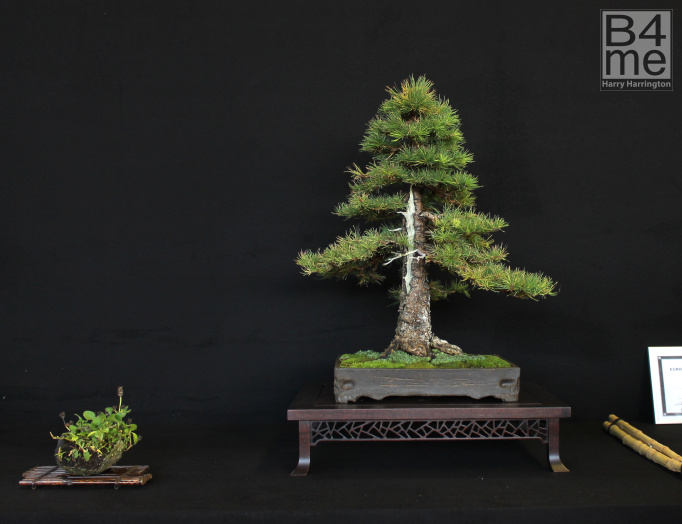
Larix is a genus of around 10 species of upright, deciduous, monoecious, coniferous trees from coniferous forests of the Northern hemisphere. They have attractive young foliage and normally display brilliant autumnal colour. The needle-shaped foliage is borne in loose spirals on long shoots and in whorls on short shoots.
Larix are a very popular species for bonsai, raw material and thick trunks are both relatively easy to obtain, it also has the advantage of its radical change in appearance of its foliage through the seasons.Its small cones that appear in Spring are usually purple in colour before browning and persisting on the tree for a number of years before dropping. Growth in Spring normally commences with the appearance of small whorls of bright green on the branches that resemble shaving brushes.
Larix decidua/European Larch
In its native central and southern Europe, Larix decidua grows extremely fast in its early years, eventually reaching heights of 50metres or more upon which it loses its narrow habit and becomes broader with a flattened crown, its branches gracefully drooping. Its leaves are 1-3 cm long, flat, soft and pale green turning to golden yellow in Autumn. It has greyish bark that forms cracks and ridges in older specimens.
Larix kaempferi/ Japanese Larch
Though native to Japan, Larix kaempferi is also widely planted in other parts of the world as a forestry tree due to its strength and vigour. Its growth as a juvenile tree is even faster than the European Larch though its ultimate height is no greater. Unlike the drooping branches of the European Larch, the branches of Larix kaempferi spread more or less horizontally. The main way to differentiate between the two species is the colour of the new twigs in winter; Larix kaempferi has a reddish colour whilst Larix decidua is yellow.
Larix x eurolepsis syn L.marschlinsii/Dunkeld Larch
A hybrid of L. decidua and L. kaempferi, the Dunkeld Larch displays characteristics of both its parents.
Larix laricina/ Tamarack (American or Eastern Larch)
Very hardy, to around USDA Zone 3. I am not familiar with this Larch species but am assured that it is regarded in the US as being superior to other Larch species. For more details of Tamarack as bonsai, Nick Lenz’ book, ‘Bonsai from the Wild’ is recommended.
BONSAI CULTIVATION NOTES
POSITION: Place in a sunny position, however, ensure leaves don’t scorch in full summer sun (often caused by a lack of moisture at the roots), Larches will also grow well in semi-shade. Larch are extremely hardy and require no Winter protection until temperatures drop below -15°C to -20°C. Note that Larch carrying wire through the Winter have been reported to be less hardy.
Larches produce shorter, more compact needles in cooler climates similar to their native habitat; in hot and humid conditions their needles will grow longer.
WATERING: Keep evenly moist. Larch kept in full sun during Summer can become very thirsty.
In hard-water areas try to use rainwater or administer a fortnightly dose of ericaceous fertiliser to stop the soil becoming too alkaline.
FEEDING: Feed heavily as soon as buds appear in Spring with a high nitrogen feed to force vigorous growth; this should be reduced for finished trees that require only fine growth. Continue to feed well until mid-summer when the tree will enter a semi-dormant period. From late-Summer onwards revert to a low-nitrogen feed to strengthen the tree for the coming Winter.
REPOTTING: Larch generally resent root disturbance and can be a difficult species to repot. Good timing of repotting is essential to avoid loss of a tree.
Repotting Larch just before and just after the buds start to turn green has long been advised as the safest time even though it can still lead to losses.
I strongly disagree and now firmly believe that January, in the depths of winter when the tree is totally dormant is the sweet spot. At this time of year I have been able to ‘push’ things with the roots of Larch and have yet to have any problems.
Don’t repot if the roots/soil are frozen. Try to remove excess soil from around the roots by hand so that they can be squeezed together to allow the introduction of fresh soil into the pot without pruning the roots. Do not bare-root or wash the roots.
The tree does not need protection from frost after repotting as the roots are very frost-hardy.
Do not bare-root and do not root prune heavily.
PRUNING: Hard pruning and formative pruning is best carried out in Autumn to late Winter, Larches need judicious pruning at this time of year to retain their shape. Maintenance pruning should be carried out through the year by pruning back new shoots; allowing new growth to extend first before pruning back will allow the branches and trunk to thicken. For a coniferous species, Larches are very vigorous and can replace newly pruned growth within a matter of weeks.
WIRING: Larches are best wired in Spring when the leaf buds are ready to sprout and the bare branches can still be seen; care should be taken not to knock off new buds. Larch branches thicken rapidly and wire should inspected regularly to ensure it is not cutting in. Old branches can be successfully wired though if the bark is rough it can mark easily and the use of guy wires is preferable. Older branches may take a number of years to truly set into position and may therefore require repeated wiring.
PROPAGATION: Sow seed in early Spring, cuttings can be difficult to root though semi-ripe cuttings can be taken in summer and hard-wood cuttings can be taken during Winter. Air-layering is successful and can be taken in late Spring.
PESTS AND DISEASES: Aphids and scale insects.
STYLING: Suitable for all forms except broom in all sizes.