
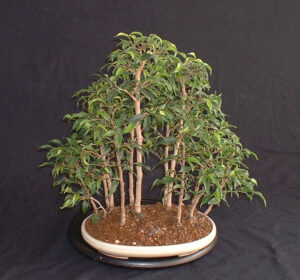
One of the most popular trees for indoor bonsai, the Ficus genus consists of over 800 different species of evergreen trees, shrubs and woody climbers usually found in moist forests in tropical and sub-tropical areas of the world. Of these there are at least a dozen species and hundreds of varieties that are suitable for bonsai cultivation.
As plants from sub-tropical and tropical areas, Figs are not frost hardy and need to be grown indoors when day or night temperatures are lower than 15°C; for much of Northern Europe this means that outside placement is only possible during June and July. Figs suitability for indoor growth is largely due to its tolerance of poor humidity levels and poor light levels that prevail in our centrally-heated homes. This tolerance to poor light is largely due to the native habitat of many Figs on the forest floor, shaded by the forest canopy above. Figs are able to tolerate poor humidity levels and dry air with their thick waxy leaves.
It should be noted though that Figs will not grow well in poor conditions; the better the humidity and light levels are, the more vigorous the plant is. Ficus bonsai should be given as much light as possible to encourage strong growth.
FICUS SPECIES SUITABLE FOR BONSAI
The following is a list of commonly used species; there are also large numbers of varieties of these species available and the suitability of these should be determined primarily by leaf size.
FICUS SALICIFOLIA/ Narrow Leaf or Willow Leaf Fig
Small, narrow leaves that produce excellent branch ramification. Is capable of producing good basal rootage and excellent aerial root formation in humid conditions. Has a habit of dropping leaves if stressed so should be kept in ideal growing conditions.
FICUS BENJAMINA /Weeping Fig
Oval, thinly leathery leaves, easily available but less desirable as indoor bonsai. Has a habit of not taking severe reduction; reductions to the trunk and the branches should be made gradually. Also defoliates easily when stressed. Branches will quickly dieback if no foliage is left on them after pruning or defoliation. Always leave a strong bud or leaf at the very end of the branch to encourage sap-flow.
FICUS RETUSA VAR. MICROCARPA/ Chinese Banyan
Bears oval, glossy, dark-green leaves upto 10cm long though these reduce with ease. The Chinese Banyan is the probably the classic fig for bonsai especially favoured for its ability to regenerate from very hard pruning, its vigour and willing to cope under poor growing conditions.
FICUS MACROPHYLLA /Morton Bay Fig
Bears glossy, dark-green leaves and small red/orange flowers. Readily produces aerial roots given high humidity levels. Rarely drops leaves and can withstand hard pruning.
FICUS RUBIGINOSA/ Port Jackson Fig
Glossy, dark-green oval leaves, again vigorous growing fig, readily producing aerial roots given the right conditions and reduces well.
FICUS RETUSA ‘GREEN ISLAND’ /GREEN ISLAND FIG
Variety of Ficus retusa that is often seen for sale, similar to previous species but is less tolerant to low light levels and poor humidity which can lead to the loss of inner leaves.
Also worth trying are Ficus burt-davyi, F.regiosa, F.deltoidea, F.aurea/ Strangler Fig, F.petiolaris, F.palmeri, F.traiangularis, F.benghalensis, F.buxifolia/ Box leaf fig, F.carica/ Common fig, F.natalensis/ Natal fig, F.pumila/Creeping Fig.
BONSAI CULTIVATION NOTES
POSITION: Though tolerant of poor light levels and dry air, try to find as bright a position as possible indoors on a sunny window-sill (Ficus will tolerate full sun), Ficus should be kept in position where temperatures do not fall below 15°C. Figs will not die from lower temperatures but continual exposure to temperatures below this level will cause a gradual deterioration in health. Do not position where the tree will be exposed to cold draughts as this can cause leaf-drop through stress. Encourage higher humidity levels with the use of a gravel tray and never place above radiators which dramatically dry the surrounding air. Temperature fluctuations should be kept to a minimum.
During the summer when night temperatures remain above around 12°C, try to place Figs outside where there is increased light, better humidity and warm air circulation to increase health and vigour levels. Most figs grow best in temperatures between 15°C and 30°C. Temperatures above or below this will slow growth; continual exposure will eventually lead to ill-health.
FEEDING: Feed only when showing active growth; do not feed during the winter if growth stops or if the plant is showing signs of ill-health. Feed with high-nitrogen or a balanced fertiliser fortnightly.
REPOTTING: Repot in Spring every two years using basic soil mix. The huge majority of Ficus bonsai imported and sold in Europe will be planted in very poor quality, congealed bonsai soil. This must be replaced with good quality, well-aerated soil at the earliest opportunity to avoid problems with disease and loss of the tree.
PRUNING: Hard prune in Spring ideally though most figs will tolerate this year round, trim new growth back to shape during the growing season. Figs bleed a milky, white sap (latex) when pruned and this can be used to seal wounds by dabbing with paper or a cloth. When pruning back smaller branches, leave a short stub which will dry out over the following days, removal of this dry stub is easy and leaves a far smaller scar in the bark.
PROPAGATION: Figs are very easily propagated from cuttings at any time of the year and from air-layerings.
PESTS AND DISEASES: Scale insects and mites can be a problem. It should be noted that Figs will not tolerate insecticides containing Malathion. Leaf loss is nearly always due to stress caused by overwatering or incorrect placement though if conditions are improved, Figs are able to leaf out within 3-6 weeks.
STYLING: All forms except Literati in all sizes.