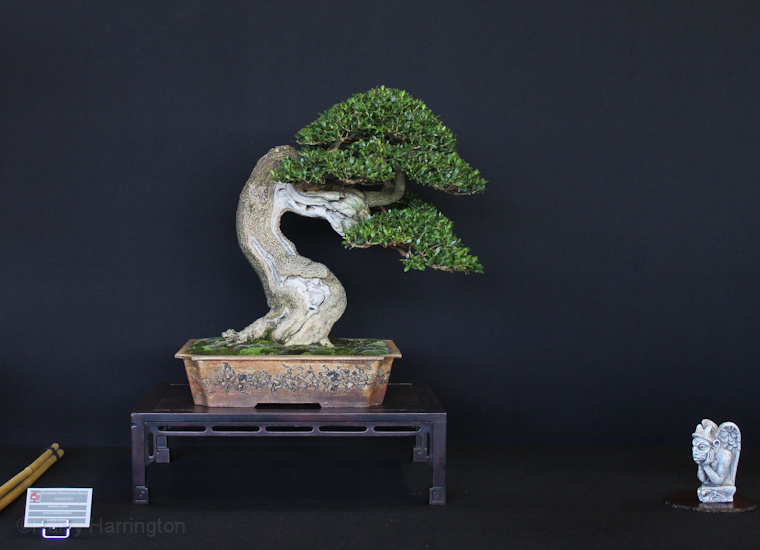
Buxus is a genus of about 70 species of evergreen shrubs and occasionally small trees found in habitats ranging from rocky hills to woodland in Europe, Asia, Africa and Central America. The leaves of many Buxus species are very small which is an ideal attribute for bonsai. In Spring, Buxus display a show of male flowers with inconspicuous yellow anthers that surround single female flowers.
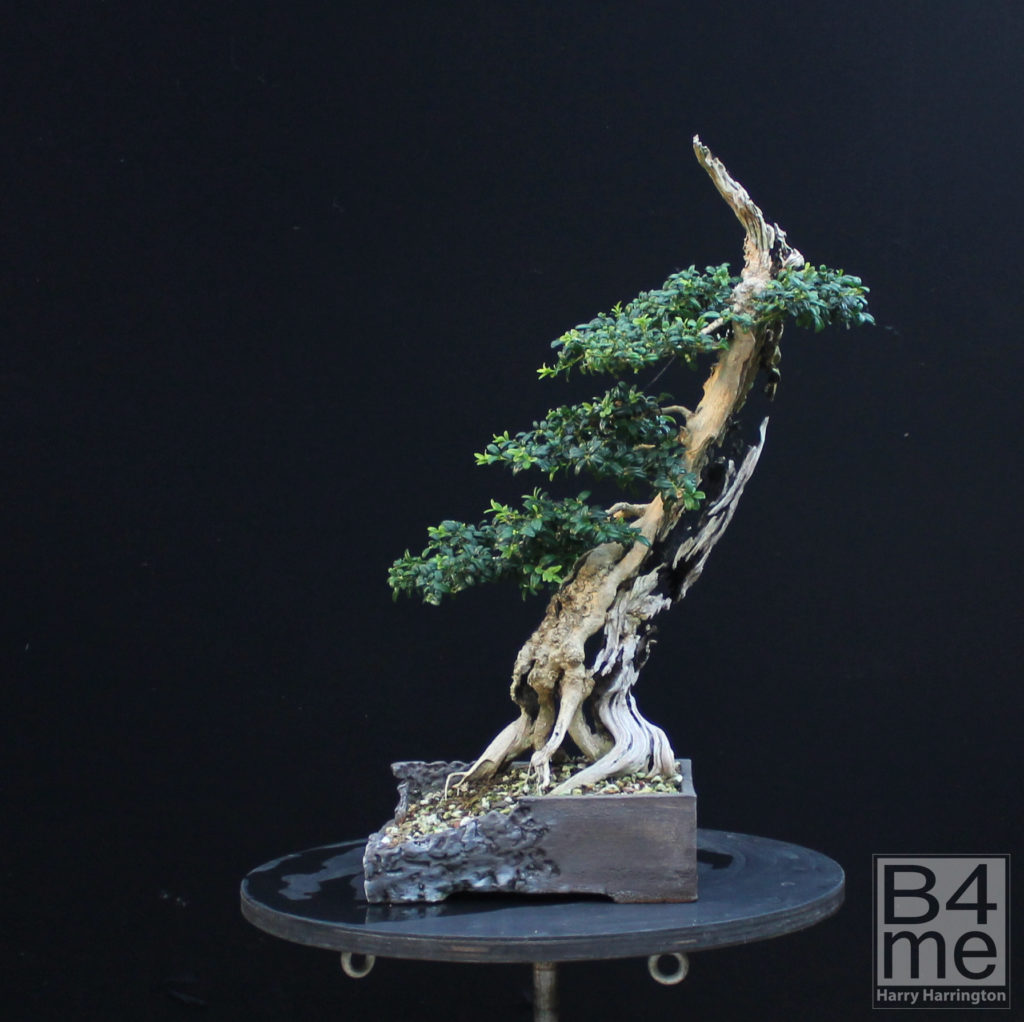
The two Buxus species that are commonly seen as Bonsai are Buxus microphylla/ Japanese Box and Buxus sempervirens/ Common Box. Outwardly both of these species are very similar, carrying elliptic, glossy, dark-green leaves to 2-3cm long. The main difference between B. sempervirens and B. microphylla is their vigour; B. sempervirens can reach eventual heights of 5metres with a spread of 5metres, B. microphylla on the other hand is very slow growing, only reaching an overall height of around 75cm with a 1.5metre spread.
BONSAI CULTIVATION NOTES
POSITION Partial Sun/ Light shade. Excessive sunlight can result in sun-scorched leaves. Both species are hardy to less than -4°C but frosts and cold winds can discolour top growth. Give additional protection to trees when temperatures drop below -5°C
Box is regarded by some as suitable for indoor cultivation during the Winter and should be placed in an unheated room with good light. Ensure good air-circulation around the tree to avoid fungal diseases.
FEEDING Every two weeks throughout the growing season.
REPOTTING Every 2 to 3 years at midsummer, Box respond better to being repotted at this time of the year than in Spring. Use a basic soil mix. Trees that are root-bound will grow very slowly indeed but with repotting will regain vigour.
PRUNING Allow Buxus bonsai to grow freely during the Spring to ensure vigour, growth can then be continually trimmed to shape through the latter half of the growing season. The natural habit of Buxus species is very angular and stiff, Buxus bonsai should be pruned and styled in a way that softens their form.
Buxus are a broad-leaved species that suit deadwood styles and small amounts of jinning.
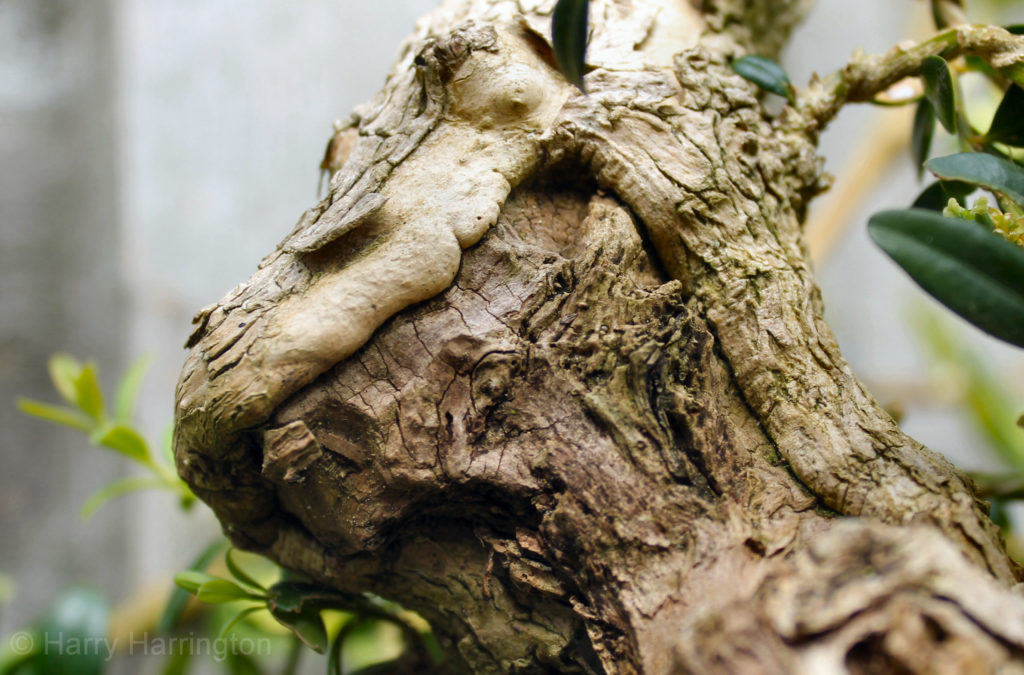
PROPAGATION Root semi-ripe cuttings in Summer. Division in early Spring. Air-layering in late-Spring.
PESTS AND DISEASES Red spider mite can be a problem in hot weather.
BOX BLIGHT is a fungal disease that has seriously affected many mature box plants in gardens across much of Europe in the past 4 or 5 years. Thought to be a ‘new’ disease and as yet has not be clearly identified. Box Blight infects the leaves causing spots that lead to rapid defoliation, it quickly moves into the stem tissue killing off smaller branches. Over a few weeks, black streaks appear on the bark and a grey-ish fungus may be seen under the remaining leaves. Within two or three months of infection the entire plant can die.
Box Blight is not only extremely virulent, it is capable of defoliating very mature plants in a matter of weeks. There is currently no available chemical remedies for this disease. Diseased branches affected by blight should be pruned off at once. To avoid spreading the disease to other Buxus plants, bin or burn infected branches, clean tools with meths, position affected trees in isolation and try to avoid contact with affected plants in damp weather.
STYLING Informal upright forms with single or multiple trunks in all sizes.
Buxus/ Boxwood Bonsai Indepth Guide
Boxwood have something of a poor image as bonsai, mainly due to the proliferation of poorly designed trees being styled with pom-pom foliage. Boxwood have a naturally multi-stemmed growth habit that lends them to being styled like large spreading park trees and it is with this style that they look their best when grown as bonsai.
The two Buxus species that are commonly seen as bonsai are Buxus microphylla/Japanese Box and Buxus sempervirens/Common Box. Outwardly both of these species are very similar. The main difference between the two species is their vigour; Japanese Box being less vigorous and slower growing than Common Box.
Boxwood have many good characteristics that are useful for bonsai. Dark green leaves that reduce well, naturally short internodes and they can take hard pruning that prompts prolific back budding. Boxwood also have shallow, fibrous root systems that often produce powerful surface roots and nebari.Japanese Box foliage
The bark of Boxwood looks mature at an early age but is thin and easily damaged so care must be taken when heavy pruning or wiring. As the bark becomes dirty very easily, accumulated dirt and algae can be cleaned using water and an old toothbrush.
Well-fed Boxwood are fast growers but are very slow to thicken. It is said that field grown Boxwood can have trunks of as little 3″ after 20 or even 30 years. For this reason it is important to source older stock to use for bonsai. Old hedges and garden material are an excellent source of suitable material. Collect Boxwood in March and April removing all ground soil (bare-rooting).
Boxwood can be airlayered successfully, and are best started in April. Cuttings can be taken from Autumn to early Spring; use cuttings of at least 4″/10cm length for greater success.
Small wounds on Buxus heal well but larger wounds, particularly on older parts of the tree, are very slow to heal and are better used as deadwood features. As Buxus wood is very hard, intricate carving and jinning can be carried out without fear of deterioriation.
Boxwood are naturally understorey trees and so it is often recommended that they are provided with dappled shade to avoid yellowing of the leaves.
However in the UK, give Boxwoods plenty of direct sunlight to encourage stronger growth and denser foliage.
Boxwood are hardy to only around -4°C, during temperatures below this, extra protection should be provided. Foliage can become yellow or bronzed after frosts during the Winter but it will green up again during the Spring.
Repot every other year and keep developed bonsai slightly rootbound on occasions; more frequent repotting can result in larger leaves as the tree becomes especially vigorous.
Pruning and trimming Boxwood
Boxwoods regularly need thinning of the foliage mass to allow light into the inner branches to stop them becoming bare and to prompt backbudding. Regular pruning helps to increase ramification and reduce leafsize as well. However, it is also important to allow some free growth to ensure the overall vigour of the bonsai is maintained. Free, unrestricted extension of the first flush of growth can be allowed in Spring (around April/May depending on your climate) to strengthen the tree, followed by strict pinching and pruning for the rest of the year to refine the foliage.