
Acer
campestre is the only truly native maple in Europe and is often
found growing in broad-leaved woods on lowlands and hills. Field
maples are very vigorous growers up to around 8metres in height
and can quickly form stout trunks with heavily patterned, rough
bark. Leaves are 3-lobed, dark-green above and blue-green underneath
and grow to around 9cm in length on specimens grown in the ground.
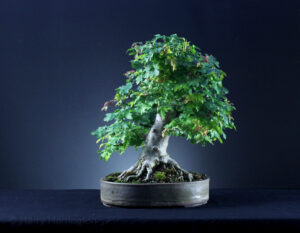
However with bonsai cultivation, leaves can be dramatically reduced
to a 1/3 of this size.
Acer campestre develop
impressive autumn colouring (as with most other Acer species) as
leaves turn bright yellow and orange. New leaves in Spring and (to
a lesser extent) through the year have a red hue to them. Flowers
appear in May but are insignificant and are followed by small red
fruit.
Bark
is a buff brown/grey and is smooth when young but develops light
coloured fissues with age. Field Maples are very long-lived trees,
reaching ages of 400 years or more. New growth sometimes develops
narrow ridges or cork 'wings' running the length of the trunk (very
similar to some Ulmus and Euonymous species).
Growth is coarser than
Acer palmatum or A. buegerianum. However in the UK, the Field Maple
is the strongest and most vigorous of the three species. Thick trunks
can be developed very quickly in the ground; it is not unusual to
see an increase in trunk girth of over 1" a year in field grown
material, with new shoots reaching over 6-7ft within the space of
a growing season. As with A. palmatum and A. buegerianum,
wounds heal over very quickly, particularly on field growing trees.
Acer
campestre can be difficult to locate in UK garden centres but
are very often found at hedging nurseries as well as from the
wild.
BONSAI CULTIVATION NOTES
POSITION Full sun throughout the growing season. Field
Maples have much stronger leaves than Acer palmatum. Weak
rooted specimens may suffer from leaf scorch in Summer and should
be afforded some protection from the sun.
Very tolerant of
frost but some frost protection is required when temperatures
drop below -10°C or for trees in very small pots.
WATERING Though
tolerant of quite dry soils, Field Maples prefer damp conditions
in a well-drained soil for maximum health and vigour. Do not overwater.
FEEDING Feed every two weeks from bud-burst to leaf-fall. Trees
in development can be heavily fed to increase growth rate and
trunksize but feed developed bonsai gently to reduce the coarseness
of new growth.
REPOTTING Every one to two years as buds extend. Developed
Field Maples are repotted less frequently in an effort to reduce
leaf-size and the coarseness of new growth.
Field Maples are
very tolerant of heavy root pruning and easily form dense, fibrous
root systems suitable for bonsai cultivation.
PRUNING Trim back new shoots to one or two pairs of leaves
throughout the growing season unless branch extension is required.
Remove all shoots with long internodes. Shoots normally regrow
after only 2 or 3 weeks.
Prune large branches
or trunk-chop either after leaf-fall to avoid excessive sap-bleeding
in early Spring or at midsummer to take advantage of very quick
wound-healing times.
Twig denseness and
ramification can be increased dramatically using defoliation techniques
and by removing large leaves and coarse growth throughout the
growing season.
For
further pruning details please refer to the Advanced
Acer palmatum article at Bonsai4me.com. The guidelines on
Trumming, Defoliation,Branch Pruning, Pinching Back, Internode
Distances, Use of Sapdrawers and Positioning as all as equally
applicable to Acer campestre as they are to Acer palmatum.
WIRING As with all Acer species, the bark of A.campestre is
very sensitive and marks easily. Field Maples also thicken relatively
quickly and wire should be checked on a weekly basis to make sure
it is not cutting in.
Growth is surprisingly
brittle; particularly that of new, green growth and care must
be taken when bending branches.
PROPAGATION Sow seed outside as soon as ripe in Autumn. Softwood
cuttings in Summer, very easily air-layered in late-Spring; branches/trunks
of 3-4" or more will root with ease.
PESTS AND DISEASES Aphids, mites, scale insects, caterpillars
and leaf scorch.
STYLING The Informal broom form is closest to the species'
natural habit, also suitable for all other forms except Literati.
Medium to large sizes are preferable but can be grown in smaller
sizes with leaf-reduction.