Over the years I have seen, heard and read so many myths about Lime Sulphur (sometimes spelt as Lime Sulfur). Why there is so much invention, misinformation and almost mystique surrounding this chemical I am not sure, but it seems to stem from less-informed bonsai literature of yesteryear.
What is Lime Sulphur?
Lime Sulphur is a foul-smelling liquid that bonsai enthusiasts brush onto deadwood in order to produce a distinctive white colour. It does not paint a coat of colour onto the wood, but rather as the lime sulphur dries, it ‘bleaches’ or ‘stains’ the wood with a white, chalky colour.
Lime Sulphur was originally developed as a winter wash (fungicide and insecticide) and used to spray trees during the Winter to kill any residual moulds, fungi and overwintering insects or eggs. It was first developed during the mid 19th century to control mildews on grapevines in French vineyards. From the early 1900’s to the 1940’s, lime sulphur was used widely and produced on a commercial basis until it was superceded by newer, more efficient chemicals.
How does Lime Sulphur stain the wood of a tree? The Lime Sulphur mixture produces a certain amount of Sulphur dioxide (SO2) as it dries (dependent on the ambient temperature, the warmer Lime Sulphur solution is as it dries, the greater the volume of Sulphur Dioxide that is produced). Sulphur dioxide is a known preservative still used in the wine-making and dried-fruits industries where it is used for its ability to kill microbes and bacteria.
Sulphur dioxide is also known as a reductant; that is, in the presence of water, it is able to ‘decolourise’/remove the colours of permeable materials that it comes into contact with (Sulphur dioxide is still used in some industries to bleach paper and delicate fabrics such as clothes). The bleaching effect of Sulphur dioxide is not permanent however, after exposure to oxygen (in the air), the bleached material is slowly oxidised and the natural, original colour or pigment of the stained material returns. This is one of the reasons why Lime Sulphur must be repeatedly applied to the deadwood of bonsai to ensure it stays white.
Lime-sulphur isn’t a pleasant liquid. Without doubt it should be treated with respect. Wear gloves when applying it. Store it out of reach of children. Wear a face mask if you use it as a spray. If you swallow any solution or get any in your eyes, seek medical assistance.
Where do you obtain Lime Sulphur?
Lime sulphur is virtually impossible to obtain at general horticultural outlets as it has long been superceded by other insecticides, fungicides and winter washes. These days, the only place you will find Lime Sulphur liquid is at Bonsai nurseries or online through Bonsai mail order companies. It is a relatively cheap product and a small bottle will last a long time.
I have only ever seen one authoritative guide to producing your own Lime Sulphur that involves boiling calcium hydroxide and sulphur and allowing it to simmer for a few hours .Given the cost of obtaining the ingredients, the danger of this process and the fact that it is extremely smelly, it is not worth trying to produce your own lime sulphur!
Materials Required for applying Lime Sulphur to Bonsai Deadwood
Together with your lime-sulphur, you will require a separate dish. Pour a small amount of the lime-sulphur solution into the dish or container. Do not apply the lime sulphur directly from the bottle as it will spoil the mixture.
You need to use a covered or old surface to work on as the lime sulphur can splash and flick as you apply it to the deadwood.The lime sulphur will stain almost anything that it comes into contact with.
You must work outside. Lime sulphur is very pungent until it dries, do not apply it indoors!
Use a paintbrush to apply the lime sulphur to the deadwood. The exact size of brush you require will depend on the size and intricacy of the deadwood but generally an old paintbrush of 1cm or less is required. It is worth finding some old artist’s paintbrushes if possible; I find that the bristles of cheap brushes tend to disintegrate quickly with the combined effects of the rough deadwood surface and the effect of the lime sulphur on the glue used to attach the bristles. Otherwise you can spend a lot of time carefully removing bristles from the deadwood!
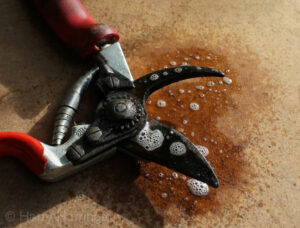
The brush can be cleaned with soapy water if done so immediately after use. However, if allowed to dry, the lime sulphur will render the brush unusable.
Lastly, have some absorbent paper cloth (kitchen roll/tissue) at hand to absorb spills and excess Lime sulphur on the deadwood.
A Practical Guide to Applying Lime Sulphur to Bonsai to Whiten Deadwood
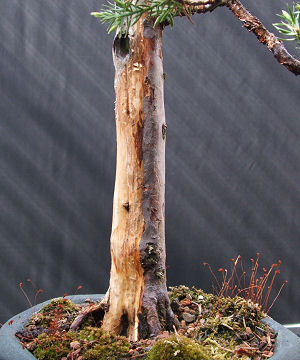
This is a Juniper trunk that has recently had its bark removed to create a shari. The live vein of growth is on the right hand side of the trunk and its edge has been sealed with wound sealant for the purposes of helping the edge of the live wood heal. It is not necessary to protect the live wood, bark or cambium (even when green) against the lime sulphur. The tree will not be damaged even if the live green cambium layer is exposed to lime sulphur.
It does not matter whether the deadwood is fresh and has just been created (from live wood) or has been ‘allowed to dry for a while’. You will find that new deadwood is slightly sappy and the lime sulphur will not take quite as well as it does when the deadwood is older, but again, it is not necessary to wait after creating deadwood before applying lime sulphur.can
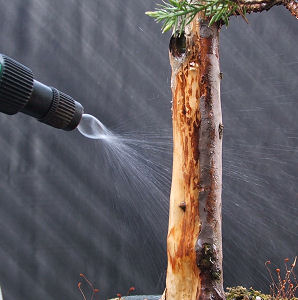
If lime sulphur is painted onto dry wood it tends to run off the wood rather than be absorbed into the wood. Lime sulphur is also unable to penetrate as deeply when the wood is dry. For the lime sulphur to have any preserving effect on the wood (however slight) it must be absorbed as deeply as possible; by ensuring that the wood is damp, the lime sulphur is able to penetrate much better.
Secondly, as mentioned previously, moisture (water) is necessary for the Sulphur dioxide to have a bleaching or staining effect. Dry wood takes much longer to whiten and in some cases can retain some of the original yellow/red colour of the lime sulphur mixture.
If the wood is not already wet from being outside in rainy weather, spray it thoroughly with water.
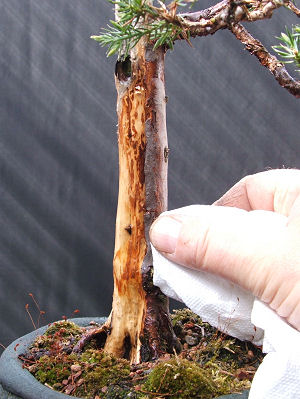
Any excess water on the surface of the wood will cause the lime sulphur to run down the wood and bleach areas of the tree that you do not require to be whitened. Use an absorbent cloth to remove excess water from the deadwood itself and try to dry the bark as much as possible.
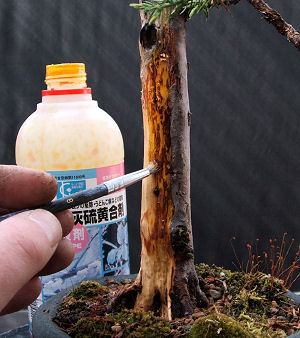
Apply the lime sulphur, starting at the highest point of the deadwood. It is better to apply several thin coats over the course of a few hours than try to apply a thick coat all at once. Any excess lime sulphur will run down the deadwood. Be prepared to mop up any excess lime sulphur that collects at the base of the deadwood you are painting.
It is necessary to mop up the excess lime sulphur before it runs into the soil or surrounding areas of live wood and bark. This is because the lime sulphur will also bleach the soil and the bark. It is not because the lime sulphur will ‘kill’ the tree or ‘damage the roots’ of the tree.
Obviously, a large amount of lime-sulphur in the soil is not a good thing for the health of the tree but this must be kept in perspective. A small amount of run-off will not poison the tree. On many occasions I have lime sulphured deadwood roots (as shown in these images) and lime sulphur has run into the soil with absolutely no detriment to the health of the tree. If you worried that too much lime sulphur has entered the soil, simply flush the lime sulphur out with water.
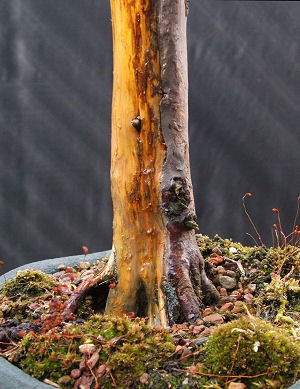
If any lime sulphur gets onto the bark of the tree, as can be seen on the base of the tree in the above image, simply use some wet cloth to wipe away the excess lime sulphur.
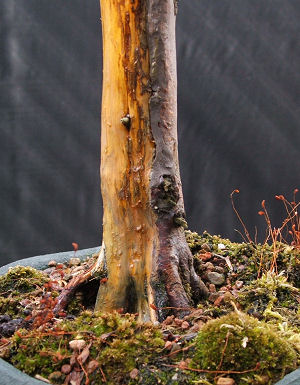
Do this as soon as possible so the lime sulphur does not have a chance of whitening the bark. If the bark still appears white when the lime sulphur has dried, just use an old toothbrush or similar to clean the bark.
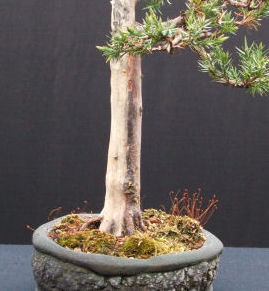
The lime sulphur will dry and whiten the wood over the course of the next hours or days depending on how moist the wood is (the more moisture, the quicker the whitening takes effect) and the ambient temperature (the warmer the weather, the faster the lime sulphur will dry). Avoid placing the tree where the lime sulphur will be exposed to rain as this will cause the lime sulphur to run off the deadwood before it has had the necessary bleaching effect.
The newly lime sulphured deadwood of the tree above is shown just hours after the lime sulphur was applied. As can be seen, the wood is not as white as can be achieved and this is normal for a first application of lime sulphur on freshly stripped deadwood. Additional applications will ensure that the wood takes on a much more even stark-white finish that contrasts well with the adjoining live wood and bark.
Colouring Lime Sulphur
By its nature, Lime Sulphur produces a white finish to deadwood. While a stark white colour is suitable for coniferous species such as pine and juniper, on other tree species such as boxwood, hawthorn, privet and the majority of deciduous and broadleaf trees, lime sulphur is often coloured to produce a more appropriate variety of tones and colours.
Additionally, because lime sulphur produces such a flat white colour with no tone or variety, it can make deadwood look very flat and 2 dimensional. Being able to darken and colour lime sulphur allows the artist to produce an appearance of depth and a third dimension to lime sulphured wood.
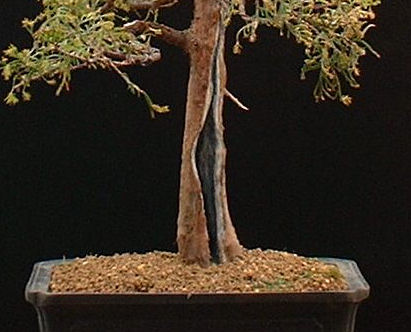
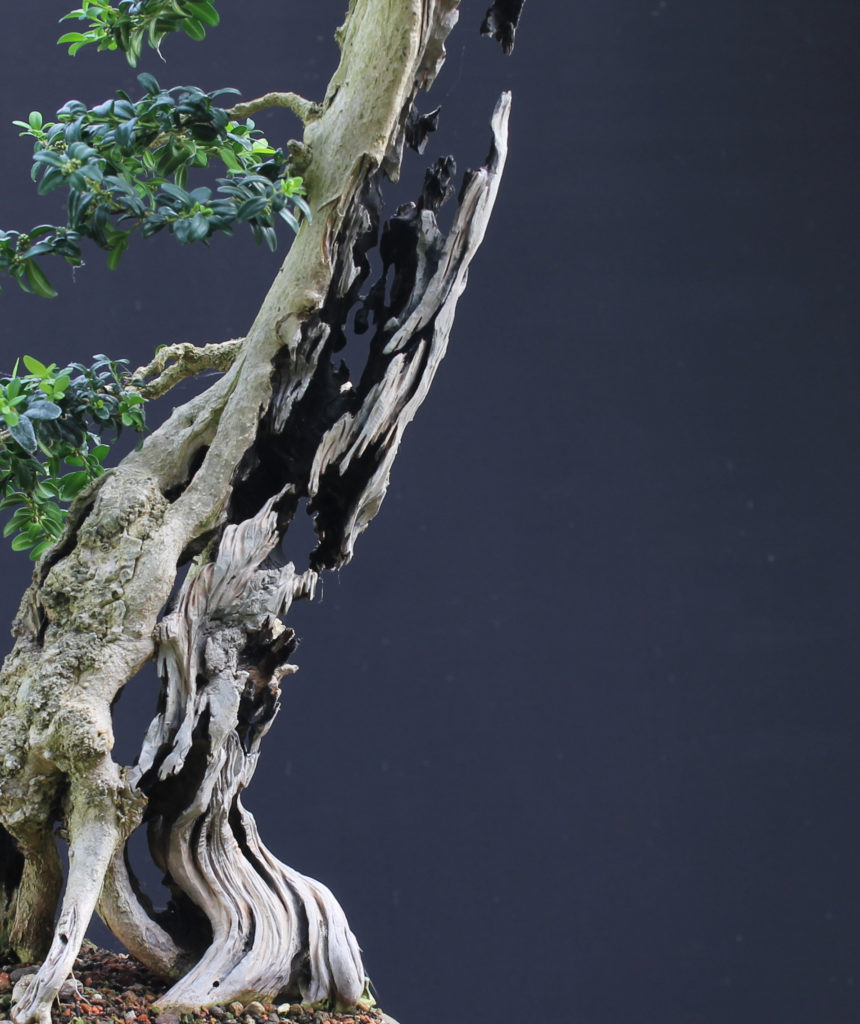
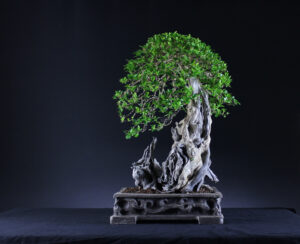
The hollow trunk of this Thuja was lime sulphured but rather than allow the lime sulphur to produce uniform white finish, the lime sulphur was carefully tinted with black ink to produce a variety of greys and black to increase the feeling of depth in the finish.
The outer edges of this trunk were painted with pure lime sulphur and then as I painted deeper and deeper into the hollow, I added a few drops of black ink to the lime-sulphur mixture to produce a steadily darker colour.
Lime sulphur can be coloured with a variety of ingredients and some experimentation is required. All water-based inks and paints will work well but avoid using anything oil-based as it will not mix with the lime-sulphur. Generally only a very small amount of black ink or paint is required for the finish to become a grey colour. For a more natural ‘wood’ colour, try ochres or burnt umber paints.
For a more ‘natural’ approach to colouring, you can use diluted (in boiling water) tea leaves, instant coffee granules or grinds to produce softened white to ochre tones. For grey tones you can use wood or cigarette ash either mixed into the lime sulphur or applied to the wood after the lime sulphur has dried.
Due to the nature of lime sulphur, it is not possible to advise of exact mixtures or recipes and experimentation is necessary. Always allow the lime sulphur to dry to its ‘final’ colour before judging the results of your work!