Bonsai4me
BONSAI BASICS  ADVANCED TECHNIQUES  SPECIES GUIDES  ARTICLES  BONSAI GALLERIES   HOME
 

Collecting and Repotting Quercus robur/English or European Oak


The English or European Oak (and also known as the German Oak in Germany) is found growing throughout Northern Europe and in particular, in the UK.
In the UK, it must be one of the most common deciduous tree species alongside Beech, Hawthorn and Birch. However, as with Birch, the English Oak can prove to be a surprisingly difficult tree to cultivate for bonsai.
The most common difficulty I have experienced with English Oak centres around its negative reaction to root disturbance. While finding most other UK natives easy to collect from the wild, I would find that Oak had a high tendency to fail, those that did survive through to the following Spring would often suffer dieback of some, or all of, the branches. It wasn't unusual for the trunk of a collected Oak to die back to be replaced by many suckers from the base.
Having had too high a percentage of large Oaks fail (2" or more diameter trunks) completely or suffer sufficient dieback to make the tree virtually worthless for bonsai, I stopped collecting them through a mixture of frustration and also a degree of guilt that I was causing the unnecessary death of these trees.

I frequently go out walking through the countryside near my home and its a good opportunity to observe the seasons and how different tree species react to their environment; the effect that the sun, rain and temperatures have on different species through the year.
One of the areas that I walk is used on occasions by off-road vehicles and I also see the effect of acute damage to trees, normally after some idiot on a quad or 4x4 has ploughed through a stand of smaller trees.

I began to notice that though my carefully collected Oak would suffer dieback or complete failure, Oaks that were being run over, partially uprooted and badly damaged by vehicles (sometimes on a number of occasions over the course of year) would always recover without dieback of branches or the trunk.
Over time I noticed that the Oaks being damaged during dormancy would dieback or die. But Oaks that were recovering were those that had been damaged during the growing season while they were still in leaf. It didn't seem to matter how dry the ground was or how badly damaged the root system appeared to be, the Oak that was in leaf would inevitably recover.

Oak are one of the last UK native tree species to leaf out, very often as late as early June in the North of the UK; they are incidentally, often one of the last species to lose their leaves in Autumn, sometimes as late as November and beyond. In accordance with the general collecting and repotting advice I have always collected Oak before the new buds start to open in Spring. In fact, I have previously tried anytime between February right up to May. Given the difficulties I had experienced when collecting Oak, until this year, it had never occurred to me to collect Oak once they had leafed out.

In early June this year, I completely trenched and undercut a number of Oaks (trunk diameters 2"-5") to the extent that the rootball could be lifted clean out of the ground.
All of these trees had their new leaves just open or in the process of unfurling. To really test my theory that Oaks respond positively to root pruning while in leaf, I cut the roots back hard leaving a rootball just 12" in diameter for trees that had a trunk 2" in diameter, and an 18" rootball for trees with a 4" or more trunk diameter.
June 2005 then proceeded to be very dry, without rain. However, every single one of these trenched-trees not only leafed out fully but they also extended new shoots, indicating that new root growth was also occurring. There was no sign of dieback, disease, weakness or even mildew (something that always seems to appear on weak Oaks with ease). The only visible effect on all of these Oaks was that the leaves were uniformly much smaller than normal.

In an effort to test my theory further, in August I decided to start collecting some Oak.
August is a very wet, humid month in the North of the UK. Night temperatures are consistently warm (never dropping below 10C) and the days tend to be cooler and importantly, more humid, particularly near the end of the month.
Along with early June, I believe mid-August to the end of September maybe optimum times to collect English Oak in the UK. During this period, the tree still has plenty of time to recover from collection before the onset of cooler days and nights in October, and of course, dormancy.

During August and September this year I collected 3 Oaks and lifted 1 Oak I had growing in my garden. Trunk diameters ranged from 2" to 3".
To push my theory as far as possible, all were completely bare-rooted, root pruned by as much as half of the collected rootball and planted into small containers.
Importantly, after potting each of the Oaks up, all 3 collected trees were then submerged in water for between 2 and 3 weeks.

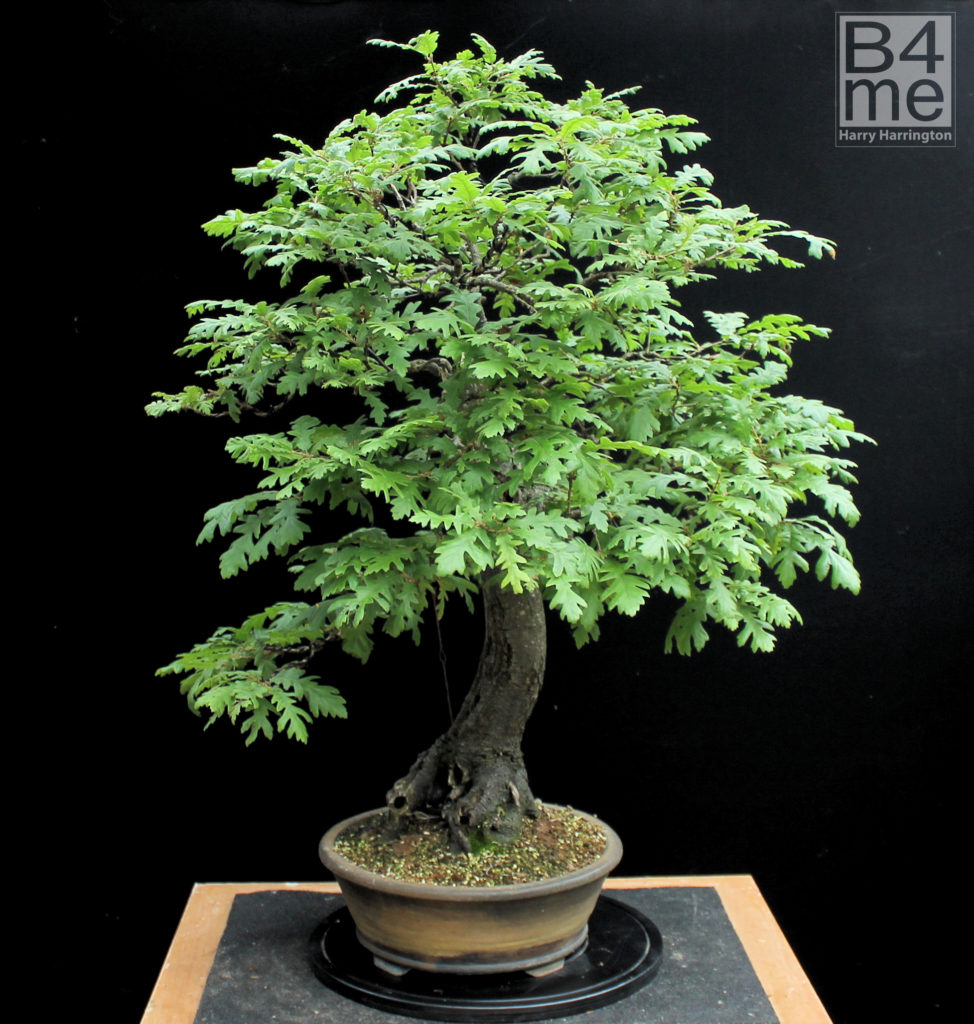
Oak bonsaiSubmerging a recently repotted tree or cutting in water is a very useful technique for trees that are still in leaf.

The abundance of water enables new roots to easily take in water and stops the leaves from becoming limp and falling.Here an Oak collected in September is shown.

For the first few days after collection, the pot was fully submerged in the water, over the past 2 weeks the pot has been slowly lifted out of the water as new roots form in response to their pruning.


The leaves on all 4 trees remained turgid at all times, no leaves dropped and there was no dieback of any kind on any of the trees. At the time of writing (mid-October) one of these trees has finished going through its natural Autumn colouring, the others still have green leaves and are just beginning to turn to Autumn colour (as would be expected at this time of year).
One of the Oaks I collected in August was also one of those I had severely trenched in early June, this was found to have tremendous new fine root growth growing from the tips of every root that had been severed during the trenching 3 months earlier.

Oak bonsaiThis is an Oak collected 3 years ago and planted in my garden to grow on. In August it was lifted, bare-rooted, and 1/2 the rootball rootpruned.

This is the same Oak 10 weeks later, no visible dieback or ill-health has occurred. The Oak was planted into a perforated pond-basket and within 6 weeks new feeder roots could be seen growing through the basket perforations.


In conclusion.

Though this year has been a limited experiment using a small number of trees, the difference in the reaction of these trees has been so profound that I now firmly believe that it is advantageous to rootprune and collect Quercus robur during the growing season, when the ground is wet (after rain) and temperatures generally cool (day temps below 25C). (As the main growing period when temperatures are at their highest and rainfall at its lowest, I would hesitate interfering with the roots once the leaves have lost their red Spring colour until mid August when temperatures again begin to cool).
I collected only small rootballs to see how far I could push the trees before they failed; I would however thoroughly recommend that ordinarily, the maximum amount of rootball is collected and retained when planting the tree in a pot to recover.
Do use the method of submerging the potted tree into water after collection; it ensures that the leaves and shoots remain turgid.
It must be noted that my findings are with Quercus robur, the English or European Oak only and not with other Oak species. It is also worth reiterating that the majority of tree species should never be collected or rootpruned at anytime other than during early Spring. To do so often causes death or severe weakness in a tree.


Copyright © 2005 Bonsai4me. All rights reserved. Reproduction in whole or in part in any form or medium without permission prohibited.


Back    Home