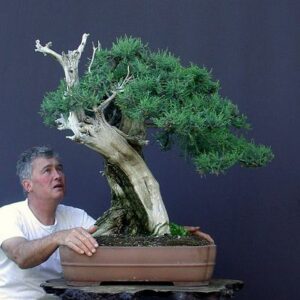
This is the second part of a series of 3 articles by Walter Pall on the subject of collecting wild trees (yamadori). Originally printed in Bonsai Today #74,75 and 76, these articles fueled my own ambition to collect old, wild trees for use as bonsai. The information contained within these articles were of enormous help in not only successfully collecting and ensuring the survival of my collected trees, but also in teaching the respect necessary before one removes trees from the wild.
More of Walters work can be seen at his website http://walter-pall.de
Evaluate the Tree
An outdoor specimen with bonsai potential has little value if you cannot be sure that it is going to survive before you dig it up. To be able to determine that, it is necessary to examine the roots. Also, you have to know what type of tree it is and what its probable reaction will be. The roots must be as compact as possible so that a solid rootball can be dug up. Sadly, many times this is not the case.
In addition, before removing the tree from the ground, you should check to see that it really has possibilities for becoming an attractive bonsai when it is shaped. The key elements are thick surface roots, the nebari and the lower area of the trunk. If these parts are not attractive now, they probably never will be. Usually, everything else can be arranged in some way.
Does the trunk have the right thickness for the final shaped height of the tree in accordance with the position of the branches? If the trunk is too thin, it is best to leave it where it is. Perhaps the crown can be pruned so that it may recuperate over the years.
Does the trunk have useable movement and appearance of age? Does the tree have lower live branches from which you can form a new apex if necessary?
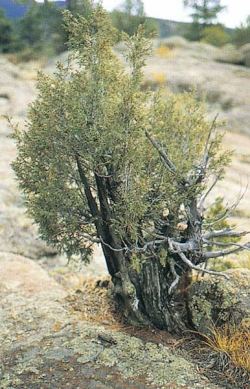
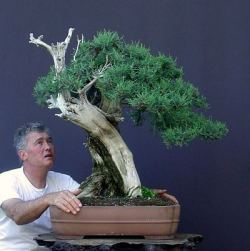
A 500+ year old Juniper collected from the Rocky Mountains collected by the author, and the same tree pictured with the Walter, 8 years after collection.
There are many dead trees next to live ones in areas where growing conditions are extreme. If you set out to look for material in Spring or Autumn, especially with deciduous trees, it may happen that it is impossible to tell at first glance if you have a dead tree or a live specimen before you. The answer to that should be clear by looking at the buds, but, in case of doubt, scratching off a little of the bark with a fingernail and verifying that the tree is green should give an answer.
Trees rooted in cracks in rocks or flat stones generally have created a very compact rootball and, in many cases, due to lack of nutrients and water, have grown into an interesting shape. Very often, these trees can be collected immediately with a compact rootball. If you are very lucky and the tree lets itself be extracted easily, you can even risk collecting it out of the usual season.
Other places that produce compact rootballs are moist areas. These areas are not necessarily wet during the entire year and over the whole surface. In marshy soils, small islands with very thin layers are created that may become quite dry in Summer. In these areas of central Europe, as in Scandinavia and Siberia, Scots pines (P. sylvestris), Swiss mountain pines (P. mugo montana) and Birch (Betula pubescens) are found. These trees can only grow during a short period, during those weeks in which the subsoil is permeated by air and quite dry. For this reason, they often grow with very little development in height and generally have a bark with a great deal of character. These trees have compact rootballs and can be removed from the soil with a sharp shovel without losing many roots and with high probability of survival.
Just the opposite occurs with trees that are growing in sand or gravel. They attract attention because of their beauty, but, in general, they are very difficult to collect. Often the roots of the small tree penetrate many metres (yards) below the poor soil searching for nourishment and it is not possible to remove them without ruining the greater part of the indispensable fine roots. In these cases, do not even think of taking the tree away, not even as a test. It is much more sensible to opt for improving the rootball and compressing the ramification right there, in situ.
The rootball can be improved by digging a deep ditch around the tree. To do that, use a sharp-bladed shovel since areas with clean cuts stimulate the new growth of fine roots. If the soil is very stony, the ditch can also be dug with a heavy pickaxe. It is important to keep the rootball intact and of a sufficient size for the tree to go on living without problems. Pruning the roots allows for the creation of many new roots and, particularly, for the growth of new root tips from the old ones. This process is similar to the pruning of branches that stimulates the development of buds from aged wood.
Since the rootball is considerably reduced, it is advisable to prune the crown proportionately. To do that properly, it is necessary to be thoroughly acquainted with the reactions of the tree. Deciduous trees have a totally different reaction from that of conifers.
A deciduous tree will usually bud from old wood if the branches are pruned a great deal. And the same can be said of the roots.
It is much more difficult with conifers. They cannot bud so easily from old wood, especially if needles are not left on so that the tree can continue to feed itself. That means that if an intense pruning (that for a deciduous tree would be suitable and would even keep it healthy) were carried out on a conifer, it would die.
For that reason, it is not advisable to prune a conifer too much if its roots have been worked on a great deal.
Once the tree’s strength is restored, it can be pruned little by little as intended for its development as a bonsai. Trying to ‘balance’ the crown and roots of the tree, as is often recommended, makes no sense. The tree itself knows much better what to do. Even Japanese collectors have had the same experience. After digging up a juniper, they leave the branches and needles intact. A year later, they can prune away long branches.
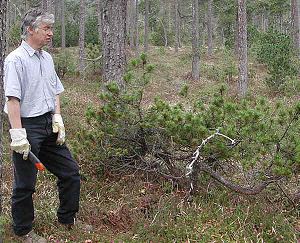
This is a mugo pine with lots of potential. Unfortunately it grows in a
forested surrounding, on very rocky and sandy grounds. It will be
extremely difficult to get enough roots when trying to lift it right away.
Proper preparation over a couple of years is the key here.
Logically, once the ditch is dug, it has to be filled in again. For that, using good soil stimulates the growth of roots. The method described here is basically a layering of the strongest roots. In layering, it is especially important that the new roots can be surrounded by soil that can retain water, but that can also drain well so that the necessary oxygen can reach the roots. Soil with these characteristics is very hard to find in the majority of places where you have found interesting material, precisely because the trees are interesting because they are found in poor soil. Anyone who wants to do it particularly well will have to bring along soil that has the same characteristics as the right soil for bonsai, according to the species concerned.
Dan Robinson has had spectacular successes in collecting junipers and pines that were considered uncollectable in the semi-deserts of the Rocky Mountains. Their roots were growing in extremely dry gravel and were too long. Dan cut off all the large roots on one side of the plant and tied a perforated plastic bag full of soil mix similar to that used for layering around the cut-off areas. He kept the plastic bag generally moist and, after a time, applied the same procedure to the other side of the tree. After this process, he could take the tree home without worrying, and with a large number of new fine roots.
Trees are often found that, due to the dropping off of their own leaves or needles, have over time created their own compost directly underneath the crown. It is a good idea to remove this soft soil very carefully and fill the ditch with it. This will also obtain the secondary effect of uncovering the beginning of the nebari. On the other hand, this is important for recognising the possibilities for future shaping and, on the other hand, since generally the structure of the bark of the trunk and that of the part of the trunk that has been underground a long time are very different, it will allow for uncovering the trunk early in the process.
To be able to obtain a natural trunk base, the structure of the bark must be identical. The bark becomes very rough due to atmospheric influences and these atmospheric influences have not affected the part that is underground. However, care must be taken not to leave the fine roots around the nebari uncovered on the surface. If the upper layer of soil were removed from them, they would likely die.
After the ditch is filled, the tree must be pruned. But the branches ought not to be pruned indiscriminately. At that time, you should have a fairly clear idea o the future shaping and should remove only those branches that you are sure you are not going to use for the design concept you have. In the case of conifers, it is advisable not to prune too close to the trunk and to leave a sufficiently long piece of the pruned branch so that, if need be, in the future it can be shaped as a jin. There will always be time to cut it off completely later on. For Junipers and Spruce, prune carefully, since they ought not to lose more than 25% of the crown at one time.
Logically, these preparations can only be made at certain times of the year. For deciduous trees and conifers, the best time is generally at the beginning of Spring. Just when the buds are starting to open, that is, during a time limited to a few days, is the safest. The exact moment varies depending on the type and also, to a large measure, on the climate and microclimate. All that remains is for the bonsai enthusiast to familiarise himself with the tree and ‘to think like it’.
In central Europe, the best time for collecting trees is between the end of March and the end of April; in the Alps and northern Europe, the best time may extend into May or even June. For conifers a good time for preparation is the end of the growing period (after the formation of the buds for the next year). But as I have already said, the exact time depends on the type of tree and the climate.
In central Europe, it is between the end of August and the end of September. In the special case of the ordinary Juniper (J. communis) and the Norway Spruce (P. abies) it is better to collect them at the end of Summer since they experience a strong growth of roots in Autumn.
This way they can survive the cold season of the year much better and in Spring they will have several weeks of time to continue growing before the hot season starts. That is just the time when they can be removed from the soil in the mountains. In the case of, it may be advisable to collect them in Spring or at the beginning of the Summer, since at that season, you can see if they are in good health. Healthy trees can be marked to be collected in Autumn.
Sometimes, coming back many years later, it is impossible to find a tree on a craggy terrain. In order to find it, it is advisable to remember some showy stone or a large tree. Visual memory is a great advantage. A drawn map is not a luxury. Even GPS receivers can be used.
Once a tree has been prepared, it should be left in peace for as long as possible between preparation and collecting; for at least one active growing period and, even better, two to four of them. But the bonsai enthusiast must be prepared to find a hole on the day he goes to collect the tree he prepared. And this also forms part of the ethics of collecting; the work of others must be respected and a tree that has obviously been prepared should not be removed from the soil, even if it is a very good one. Usually bonsai enthusiasts are honest.
Sometimes you may find a fabulous tree, but one that is impossible to collect. In cases like this, the possibility of layering must be considered. This works, for example, with Junipers including very old ones.
When searching and collecting, bringing a camera is always worth the trouble. A photograph of the place will always be incalculably if the tree has become a lone tree ten years later. Also, a photograph of the tree can be taken that will augment your collection, if it is not possible to collect it.
Digging the Tree Up
Whether because the tree was prepared well ahead of time, or because the tree has a naturally good rootball, the time will come when it will have to be removed from the soil if you want to make it into a bonsai one day. To do that it is essential that that time be the right time.
Once that time has come, the experienced bonsai enthusiast will have prepared one or more large-sized containers. He will have placed screens over the holes, mixed a large amount of soil with good drainage and, in short, will have prepared the whole work area well.
If it not has been done already, this is the time to prune away everything you are certain you are not going to need in shaping the new bonsai. If however, nothing has been definitely decided on, it is better to stop for a moment to think about what is going to be done.
The likelihood of the tree’s survival will be greater if, shortly before removing it from the ground, a heavy rain has fallen. Thus the tree will have absorbed a large quantity of water and will be capable of withstanding the shock better. Of course, this doesn’t necessarily mean that on the day when you carry out the operation it has to be raining cats and dogs!
During subsequent weeks, it would be better if the climate where you are going to locate the tree were pleasant. High temperatures without rain are like poison for most trees, including even those that have not been collected recently. If there is soil, grass weeds, stones or other material on top of the rootball, you should remove it very carefully.
With a sharp-bladed shovel, try to remove the largest rootball possible, although if the rootball is very stony, it may be better to work very carefully with a strong pick. The rootball should have a diameter of at least seven or eight times the thickness of the trunk. That means that if the trunk has a diameter of 2″ (5cm), you will have to mark a circle with a diameter of at least 14″ (35cm).
The depth depends on the terrain and the type of tree. For safety and in case of doubt, it is best to dig very deep, by at least three times the width of the tree. It would not be the first time that, after removing a tree from the soil, it is found that the main roots went much deeper than expected. What appeared to be the roots of the tree may turn out to be the roots of small nearby shrubs.
It is also advisable to check the position of the roots before removing the tree from the soil. To do that, clear the base of the trunk, grasp the tree firmly by the trunk and move it carefully. With a little experience it is possible to determine in what direction the main roots are growing.
In wet areas, they usually grow toward the side that gets the sun and, in dry areas, toward the shady side. Many times, it will be necessary to remove a lateral root mass if the main roots have a strong tendency toward one side.
It may also happen that roots are found that are so thick that it is not possible to cut them cleanly with the shovel. For that, sturdy branch cutters should be on hand in order to make clean cuts on branches or roots up to about 2 ½” (6cm) in thickness.
The majority of trees have a main root that penetrates the soil vertically, almost precisely underneath the trunk. It is essential, although difficult, to cut it back very carefully. To do that, the shovel is introduced from a certain distance, on a level, underneath the tree. If it doesn’t work, it is also possible to work underneath a tree with branch pruners. For very large trees, it may be possibly necessary to remove them with a block and tackle anchored to another tree. In any case these tasks must be performed very carefully in order not to harm the small roots. It is not so important as you often think it is for the rootball to remain intact. In fact, it is most likely that, in finally removing the tree from the ground, it will fall apart. It is much more important to keep the largest possible amount of fine roots. I have often have good results by shaking off the rootball very carefully immediately after removing it from the soil. Clearly, you must always remember to keep a great deal of fine soil, so that the tree can preserve its mycorrhiza.
If it is possible, you should not try to remove the tree from the hole by pulling upwards on it, but instead by pulling it to one side, placing a cloth underneath it and then making it roll over the cloth toward one side. Then it should be possible to reach under the tree from the opposite side and pull the cloth. Next, knot the cloth so you can then proceed to remove the tree from the hole. Clearly, if the rootball is truly compact, you can take it right out of the hole and then wrap it.
Medium sized or small trees can be put into plastic bags. For large trees, possibly plastic garbage bags would be best, since they can be closed very well and they hold moisture for a long time. If you want to do things correctly, moss should be brought to fasten around the roots, although you can substitute wet newspaper for that.
Sometimes a good tree is found, but it is not possible to transport it immediately. By wrapping the rootball with wet moss and leaving it in the shade, you can leave it this way for several days without any problem. In any case, it is important that, during the often long and difficult transportation to the car, the fine roots not be damaged and, above all, that they not dry out. Some rootballs crumble, damaging many roots due to shaking during transportation. For this reason, it is often advisable to remove soil from the rootball with great care before transporting it.
However, in the case of Junipers and pines, this should be avoided as much as possible, since these species depend a great deal on having the roots keep the original soil of the place where they were found with the proper mycorrhiza. If the road to be traveled is very long, enough water for the person to be burdened with it should be carried.
Generally, trees that are found are much larger and voluminous than you want. When planting them, it is advisable to prune them to a greater or lesser extent. If you do this task before transporting it, you will make the operation easier.
Once out of the ground, it will be much easier to check whether you have pruned off everything that you are not going to need now you can see the tree in much greater detail (including the beginning of the rootball) and it is much easier to get an idea of possibilities for shaping.
The experienced bonsai enthusiast will determine the basic shaping right there and will prune off what is not going to be part of said shaping.
But, be very careful with conifers. Pines, Spruce and, although to a lesser extent, the Larch and Juniper suffer greatly if they are pruned too much. Their metabolism will be so confused that they will then have great difficulty in developing or they might even die in spite of having a fine rootball. You can tie an excessively voluminous crown with the rope that we advised you to bring at the beginning of this series of articles, although adhesive tape for wrapping packages may be substituted for it.
The best results are obtained with trees that do not have to be dug up, that is, those that have rooted in a crack or over a stone and only have to be lifted off. Perhaps it will be necessary to cut off some roots with pruners or even a saw. These quasi-bonsai that have had to survive most of their time with very little space for their roots, can be transplanted directly into a pot and, after one growing season, it is already possible to begin shaping them.
If you have the luck to know a location where trees can be collected from rocks, go equipped with the necessary tools. It is very useful to have a large, solid pick available. It is also very helpful to carry a crowbar and a heavy hammer. Perhaps you will have to work with a block and tackle. A special band saw that can be placed around a root so it can be cut even in difficult positions, is worth its weight in gold.
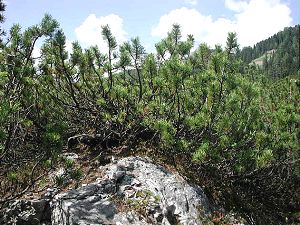
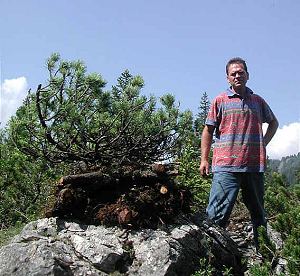
This mugo pine sits right on top of a big boulder.
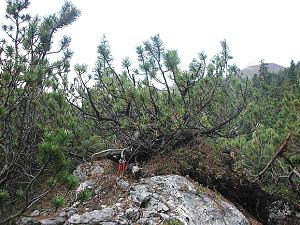
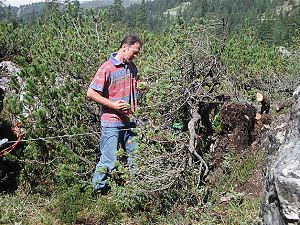
This is the very best situation for outstanding material with very high survival hopes.
It should be possible to collect it with a firm rootball. But here one can see that for some big trees extra efforts are necessary.
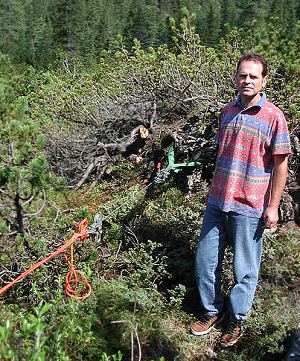
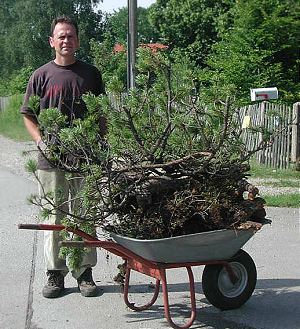
After cutting the tree’s roots and reducing the foliage, a wrench is used to pull it off the rock.