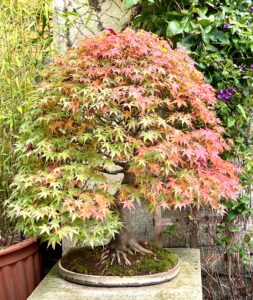
This article describes the technique of approach grafting new roots in an otherwise blank area of the nebari or trunkbase.
It is strongly advised that the article ‘Approach Grafting’ is first read and understood before applying any techniques described in this article. A second useful and related article is ‘Threadgrafting New Roots’; both threadgrafting and approach grafting new roots are equally viable techniques and should be seen as techniques that can be used individually or in conjunction with each other.
Example Approach Grafting of an Acer palmatum Sapling
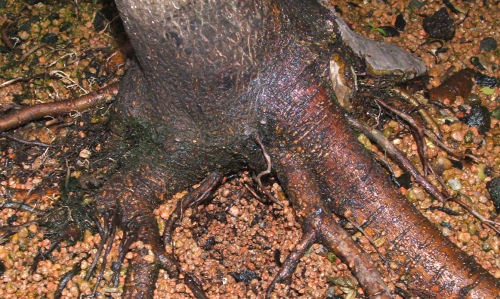
This is the trunkbase of an Acer palmatum/Mountain Maple in development. Having been grown in the ground for several years to thicken the trunk to its present 3″-4″ diameter, the tree is now being refined in a large nursery pot. Part of the process of refinement is the continued development of the nebari.
At the front of the trunk is a large gap in the nebari or rootspread. Roots could be prompted to grow from this point using a number of hit-and-miss techniques, however, these new roots would be very thin and would take many years to thicken to the same girth as the surrounding surface roots.
The fastest way to introduce a suitable root in this position is to either threadgraft or approach graft a young tree into the gap in the trunkbase. Once grafted, the trunk of the young tree becomes a root of the main tree itself.
Due to the thickest of this trunk and in particular its trunkflare, approach grafting is by far the easier of the two techniques to apply in this situation.
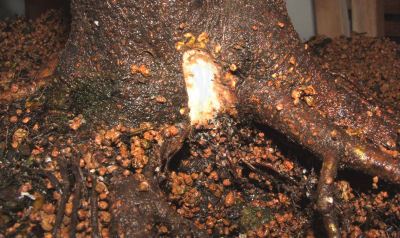
Not long after midsummer (see timing notes below), a channel that will receive the sapling (scion) is cut into the front of the trunkbase . Sufficient soil is removed from the area where the scion will be planted. The roots of the main tree are disturbed as little as possible.
A small amount of disturbance, to a tiny fraction of the overall root-mass of a healthy tree during the growing season doesn’t cause any problems.
If one is fearful of disturbing the roots of the main tree during the growing season, one alternative is to place an object (such as a stone or small plastic pot) into the soil area during repotting in Spring. The object can then be removed during the Summer to leave a planting pocket for the scion.
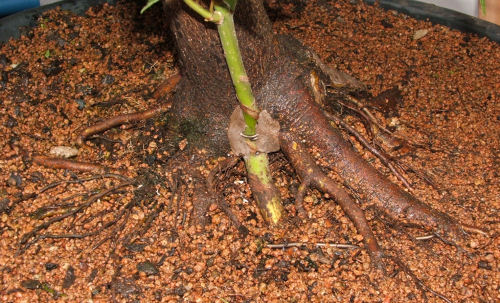
A pencil-thick Acer palmatum scion (in this case taken as a small airlayer during the previous year) is then inserted into the channel and securely fixed into position using a brass screw and an aluminium wire staple.
As can be seen in the image above, the scion still has the green bark seen on Mountain Maples for the first decade. In this case, the scion will be covered with soil to speed up the maturing of the bark so that it quickly forms the same colour as the surrounding roots and trunk.
As with newly approach-grafted branches, having been sealed the graft with wound sealant, the scion will now be allowed to grow freely and vigorously until such time that the cambium layers of the scion and main trunkbase graft together.With this tree this will take between one and two years. The top of the scion will then be removed leaving the base of the scion as a new root.
UPDATE July 2008
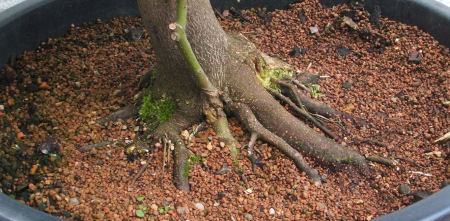
Early July 2008 and the graft has healed well. Both of sides of the cambium layers have grown tightly together
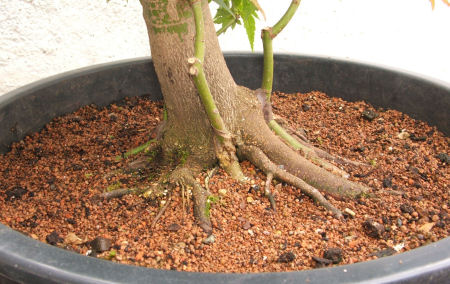
An additional 4 approach grafts have now been made to further enhance the nebari of the tree
Preparing a Scion for Approach-Grafting New Roots
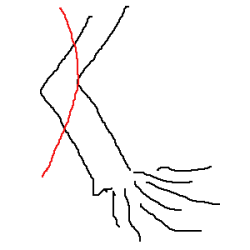
The scion or seedling/sapling tree to be grafted needs to be prepared and shaped in the months prior to grafting. This is necessary so that it will fit into position at the base of the main trunk. Suitable scions can be obtained from seed, cuttings or airlayers.
For the majority of approach grafts, the scion should be:
(a) bent so that there is an ‘elbow’ in the scion that can be inserted into the channel in the main trunk
(b) the part below the elbow grows into the soil surface at the same angle as the surrounding roots of the main tree.
(c) the part above the elbow has room to grow freely (allow it to grow out, away from the trunk and branches of the main tree)
(d) though not essential, if you have the opportunity, train the roots of the scion as shown in the diagram above
(e) prune the scion roots in the Spring before grafting so that they are reasonably compact and can be replanted into the main tree’s soil later on in the year. I would not recommend any rootpruning of the scion at midsummer itself.
Timing: Speed of Callousing vs Health of the Seedling when making Approach Grafted Roots
When approach grafting young seedlings to the base of a bonsai, there is something of a quandary. Is it better to make the graft in the Spring/during dormancy when it is safer to disturb the roots of the seedling but wound healing or callusing of the bonsai is poor or non-existent? Or, do you make the graft during the Summer when the graft will take more quickly though it means exposing and disturbing the roots of the scion while it is in leaf?
As discussed previously, I believe it is a case of weighing up the risks of both dieback of the channel edges and the possibility of poor or slow grafting or the risk of exposing the roots of the seedling during the growing season.
Roots can be and are often approach grafted to many species in early Spring but I would thoroughly recommend summer grafting for those species with poor callusing characteristics or species with a tendency to dieback around the edges of wounds.
In general, I prefer to carry out all approach grafts during the Summer. To minimise any risks to the scions, I ensure that they are root pruned as appropriate during the preceeding Spring and planted individually into small seed-pots so that the scion can be lifted from its container and planted (and grafted) to the main tree with minimum disturbance.
Separating the Newly Grafted Root
As described previously in the article ‘Approach Grafting’, the exit or ‘top’ of the scion will become noticeably thicker than the entry or ‘bottom’ of the scion. This allows one to determine that the scion has grafted to the trunk.
Obviously, in this case, it is the base of the scion that is kept and so the exit or ‘top’ of the scion is removed and dressed almost as though it is simply a low branch being removed.
In the case of newly approach-grafted roots on deciduous and broadleaf species, I find that there is a tendency for the scion to produce new buds and shoots for anything up to 2 years after grafting. These should be removed as and when they appear.
Failure of an Approach Graft
Approach grafted roots cannot really fail and die; they simply take a very long time to graft to the main or host trunk. However, there are several reasons why an approach graft can be very slow to graft to the main trunk.
Firstly, it is of great importance to recognise that strong callusing of the main trunk is necessary for the cambium layers of the scion and main trunk to be forced together in order that they can graft. Strong callousing is produced by fast growing, healthy and vigorous trees and tree species.
A sick, weak or slow-growing rootbound bonsai will not callous strongly enough to graft very quickly. Equally, the scion must be healthy, well-fed and allowed to grow freely in order that it thickens enough for its cambium layer to be forced against the cambium layer of the main tree.
Lastly, patience is essential. Successful approach grafts are not a quick process.
Further Examples of Approach Grafting
As with approach grafting new branches, grafting new roots is not a difficult technique to carry out. However, it is much harder to know in which situation approach grafting is suitable or appropriate. Much depends on individual tree species, individual specimens and the best timing for the given sitiuation.
Here are two further examples of approach grafting roots;
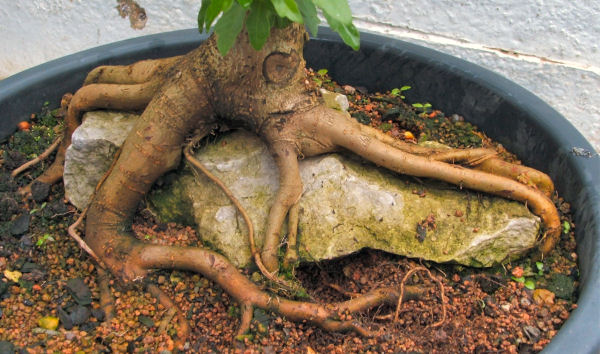
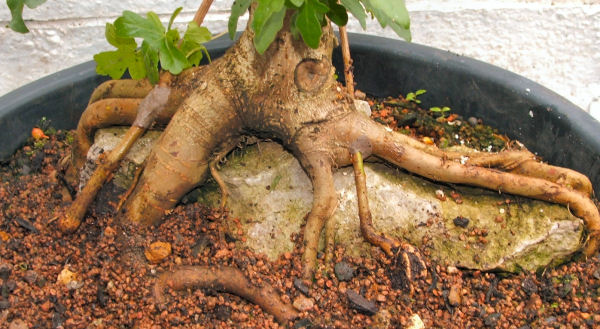
This Field Maple (Acer campestre) root-over-rock has a poor spread of roots (top image). To improve the appearance of the roots, a young field maple seedling is approach grafted (on the left) and a second seedling (on the right) is threadgrafted. Both of these grafts were carried out at midsummer.
UPDATE July 2008

The two grafts made during the summer of 2007 (shown above) have healed well; additionally another dozen new grafts have been made to further develop the root spread.
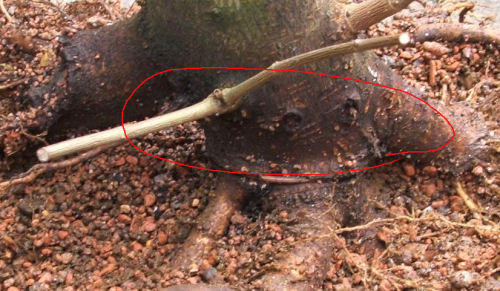
The above image shows the back of a second Acer campestre bonsai with its surface roots uncovered during repotting. Though there are roots at the back of this trunk, they are too low and new roots are needed in the middle of the area circled in red.
Previous attempts to prompt new roots have included a wire tourniquet (just visible below the circled area) and drilling holes in the trunk (these are filled with rooting hormone and can sometimes prompt new root growth around the wounds. In this case it just prompted a sucker above one of the three holes).
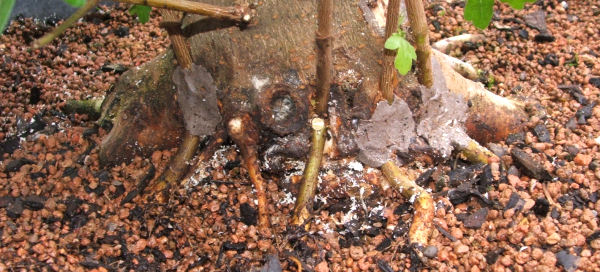
This second image shows the same trunk 2 years later after 4 saplings have just been approach-grafted. The second root from the left is a successful approach graft taken just 12 months previously.
The root to its right has just been grafted but not yet sealed. In this image it is possible to see the tiny brass screw holding the sapling in place.
For a more detailed article covering the root development of this bonsai please see
Grafting a Better Nebari onto a Acer campestre/Field Maple