Though Pinus mugo has something of a poor reputation as bonsai, with the correct techniques, Mugos are easy to cultivate and style.
Mugo pines (also known as Mountain Pines) are easily available at garden centres and nurseries compared to most pine species. It is recommended that the plain Mugo Pine is used as Mugo varieties tend to be weaker and unresponsive in comparison. Try to find ordinary landscape pines rather than the miniature rock-garden varieties such as P. mugo ‘Mops’ and ‘Valley Cushion’ that are known as being particularly touchy to bonsai cultivation.
Mugo pine care
Mugos like plenty of light and water to achieve their full potential, however they must have a fast draining soil so that their roots don’t sit in water. For maximum health and vigour, feed Mugos strongly with slow release fertiliser from Spring through to late Summer.
Repotting Mugo Pines
Pinus mugo has a bad reputation for reacting badly to repotting and rootpruning. It is not unusual to hear of Mugos becoming weak or even dying after a Spring repotting.
Unlike the timing for the Japanese Black Pine which is normally repotted as they come into active growth (the candles have extended and the new needles can be seen held tight against the candle). Mugo pines react far better to Summer repotting.
Following comments I read on the internet last year that Mugos dislike being repotted in early Spring and respond strongly to be repotted while active in the Summer, I repotted 3 Mugos last August with great success. The Mugo pine appears to be one of a few tree species that actually prefer repotting and rootpruning during the growing season.
The ideal repotting time would seem to be after the first flush of growth has extended and is cut back (see below) and before the end of the Summer; this equates to July and August in most climates.
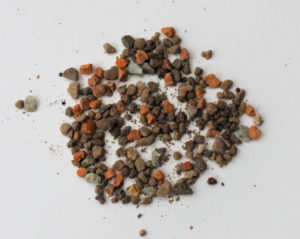
With a healthy mugo, all of any old, poor draining soil that is found can be removed by hand but do not wash the roots. This allows new, fast draining soil to be introduced around the rootball without removing the natural mycarrhizae attached to the roots. If you have any doubts as to the strength of the tree, only remove 50% of any old compacted soil that is found, removing the remainder in the next repotting.
It is not necessary to prune any of the foliage of the pine after rootpruning to ‘balance’ the tree. The waxy needles of a Pine require relatively little moisture uptake from the roots, there is no need to try and reduce transpiration through the removal of above-ground growth. The more foliage the tree has after rootpruning, the more strength it will have to repair and regenerate the rootmass. The tree will ‘balance’ the roots and foliage itself.
After repotting during the Summer, if temperatures in your climate are above an average 80°F (approx) keep the tree out of direct sun for a couple of weeks (only) and lightly mist the foliage a couple of times a day, otherwise no special provision is necessary.
Insulting a Pine
Healthy and vigorous, immature landscape or garden centre Mugos can be repotted, pruned and wired all at the same time after the first flush of growth through to early September. However,after this initial styling, the tree then will require 2 or 3 years to recover.
Be wary of reducing a nursery Pine’s top growth by more than 50% in one vegetative period. Reduce the height of the trunk (and foliage) slowly in comparison to deciduous tree species.
Mature Mugos are much like other Pine species in that they will only take one major working every year.
The general rule with mature (over 30-40 years) Pines is to keep to ‘only one insult per vegetative period’. After repotting or drastic pruning or wiring or styling you must then wait until 12 months elapses before carrying out any further work. This also means that if a Pine is styled in the Summer, it cannot be repotted the following Spring.
Immature pines can be worked much harder and it is possible to get away with less time for recovery but it is important to respect that Pines must always be worked slowly.
Mugo Pine Pruning
Bud Selection
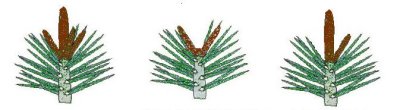
As with other Pine species, the number of buds at any one point on a branch is always reduced to 2 so that the branch forks into two sub-branches. Remove excess buds as and when they appear. (For more information on Pine bud selection and Areas of Apical Vigour and Weakness see Pruning Pines)
Bud selection on a Mugo Pine is required in early Spring and during the Summer after the first flush of growth is cut back.
Candle Pinching
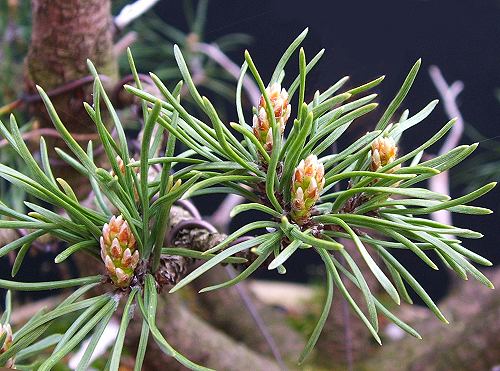
During the Spring, the buds that you have retained will elongate into candles, their size being in relation to each candle’s individual strength and vigour. To ensure that growth extension is regulated and energy is dispersed evenly throughout the whole tree; very strong and vigorous candles need to be pinched back.
Though the principle of Pinching Back Candles remains the same for Pinus mugo as it does for other Pines, the timing and technique does differ.
For Mugo Pines, if at any time a candle reaches approximately 1″ to 1.5″ in length and is noticeably longer (and therefore more vigorous) than other candles on the tree, gently break away the top of the candle with your fingers. This will stop extension of the candle and redistribute the energy of the candle to weaker areas of the tree.
If new growth is required to extend to fill out a branch or strengthen a weaker branch; leave the candle to extend without pinching.
Mugo Pine Summer Pruning for Backbudding and Ramification
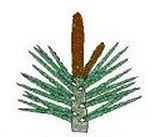
The technique for increasing the ramification (foliage density) of a Mugo Pine and prompting backbudding is very straightforward. In Spring, the number buds at the tip of branch (the tip of last year’s growth) have been reduced as previously described and begin to extend into candles.
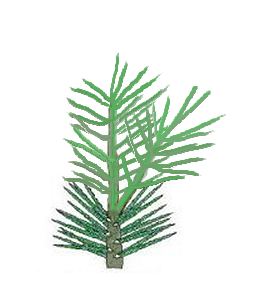
During the Spring and early Summer (the exact timing will be in accordance to your local climate), the first flush of growth extends and the new fresh-green needles emerge. This seasons first flush of growth is much brighter and softer than last year’s hardened growth.
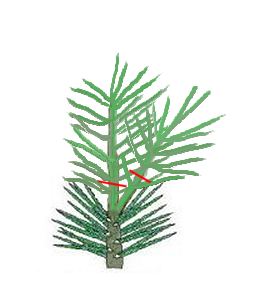
If these new shoots are left alone, they will simply harden off through the remainder of the year and will not produce new growth until the following year.
However, if the new shoots are cut back hard in early Summer, the tree will be forced to produce a second flush of growth within the same season. Having already had to produce one set of new growth, the tree will have limited resources for this second flush of growth and the result will be very compact growth with short extension and short needles; ideal for developing the foliage mass of a Pine bonsai.
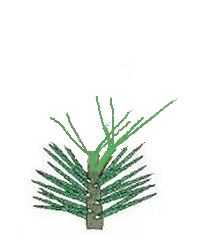
The exact point that the first flush of growth is cut back to depends on the strength of each branch. In strong, apical areas of the tree, the growth can be cut back to just two or even one set (pair) of new needles. In weaker areas of the tree (inner and particularly, lower branches), cut the fresh growth back to 3 or even 4 sets of new needles. Leave new growth that has only marginally extended and is very weak; this includes any shoots created from backbudding in the previous 2 or 3 years.
Never remove all of the new growth on any branch. It is important that at least one set (pair) of new needles remain.
This hard pruning of the first flush of growth prompts strong back budding in Mugo pines.
It is at this point that needle-plucking is carried out on a Mugo Pine. However, unlike Japanese Black Pines, Mugo pines backbud from where old needles remain on a branch not where they have been removed (plucked). So, whereas Japanese Black Pines are needle plucked to prompt back budding, the older needles of a mugo are kept in areas where backbudding is required.
Only remove the needles from the areas of last year’s growth, where you don’t want the tree to backbud; particularly along the underside and the top of the branch.
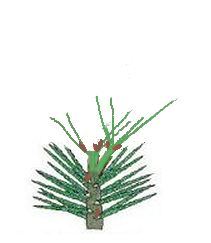
The result of the hard pruning of the first flush of growth will be that the tree produces a second flush of buds, some of which will be further back along the branch. With dimished resources in the tree and a shorter period of the growing season left, the second flush of growth will be shorter and more compact with smaller needles (not shown).
Any new back budding that occurs further back along the branch will be relatively fragile and dislodged easily. Take great care of them until they strengthen over the following 2 or 3 years. Wait at least 2 years before attempting to wire or prune these fragile buds.
Styling and Wiring Mugo Pines
Young Mugo pines will tolerate styling and repotting during the Summer. However, it is ordinarily recommended that the styling and wiring of Mugo pines is carried out in late Summer/early Autumn as with other Pine species.