Layering is a method of creating new bonsai or ‘potentsai’ from trees or shrubs that, in their present state or stature, are undesirable or unsuitable for bonsai cultivation.
Bonsai can be created from well formed branches of fully grown trees, poor quality bonsai can have desirable sections rooted and separated from the rest of the tree, good quality material with poor nebari can have new suitable nebari formed as air-layering produces roots emanating radially from around the new trunk.
Layering is also a straightforward method of propagation that although relatively unused in the West, has been tried and tested in China and Japan for centuries. For some species such as Acer Palmatum and Azaleas, layering is the most reliable way of creating new stock vegetively.
The principal of layering in all its forms is to injure the wood of the parent tree, so that the flow of nutrients from the parent trees’ roots to the layering’s leaves is kept intact, whilst the flow back from the layering’s leaves to the parent trees’ roots is interrupted.
The injured part of the bark slowly heals, forming a callus from which adventitious buds are able to form new roots into the growing media. The layering continues to be supported by the parent tree, however, the food energy its leaves produce go into building its own new roots. When the layering has sufficient roots of its own, it can be separated from the parent and is then able to support itself.
Layering should always be carried out in Spring when the first flush of leaves has hardened on the parent tree and the parent tree is putting on a great deal of root growth of its own. This timing allows enough time for a layer of many tree species to become established on their own new roots before the onset of the following Winter.
Ground Layering
This form of layering mimics the process by which some species propagate themselves naturally. Low branches on some plants come into contact with the ground as they lengthen and become weighed down by their foliage; from these points, adventitious buds produce roots into the ground and the root system eventually becomes established enough to support the branch as a plant in its own right.
Suitable species for ground-layering include Acer, Azaleas, Berberis, Buxus, Chaenomeles, Chamaecyparis, Cotoneasters, Euonymus, Forsythia, Hedera and Wisteria. It is always worth investigating around the base of all of these species when found growing in the garden or field to see if there are any naturally occurring ground-layers that can already be removed.
To create ground-layers artificially, try to find fairly young growth that will touch the ground; make an upward slit in the underside of the bark where roots are required. Dust with rooting hormone and wrap the wound with long-stranded sphagnum moss. The section of the branch to be rooted now needs to be shallowly buried in the soil and pegged in place with a piece of U-shaped wire.
This process should be carried out in Spring and should be left for at least three months ensuring that the area is kept damp. If the layer has failed to root after 3 months, re-cover it and leave until late-summer. If it has still failed to root by this time it is still worth leaving it in position until the following Spring. When successfully rooted, the new plant can be removed and planted up.
Don’t be too eager to separate the layering, it is better to leave it intact until there is enough rootsystem to support the layering, rather than remove it too early and watch it slowly die. If there are not sufficient roots on the layering by September, it is better to leave detaching it until the following Spring as an new immature layering may not survive on its own through the Winter cold, however hardy the parent plant is.
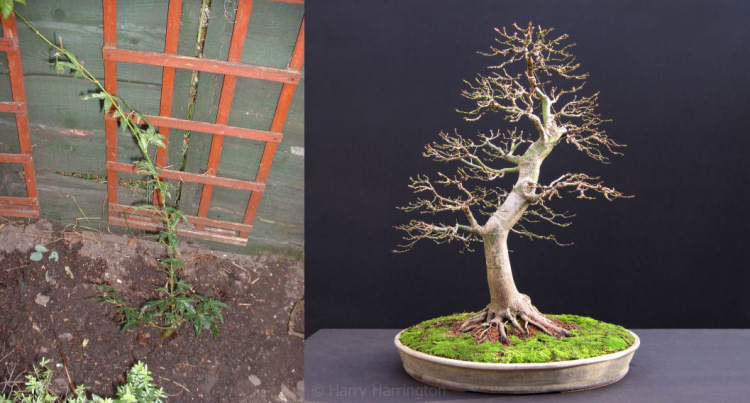
Japanese Maple airlayer in 2002 and as a large bonsai, 9 years later.
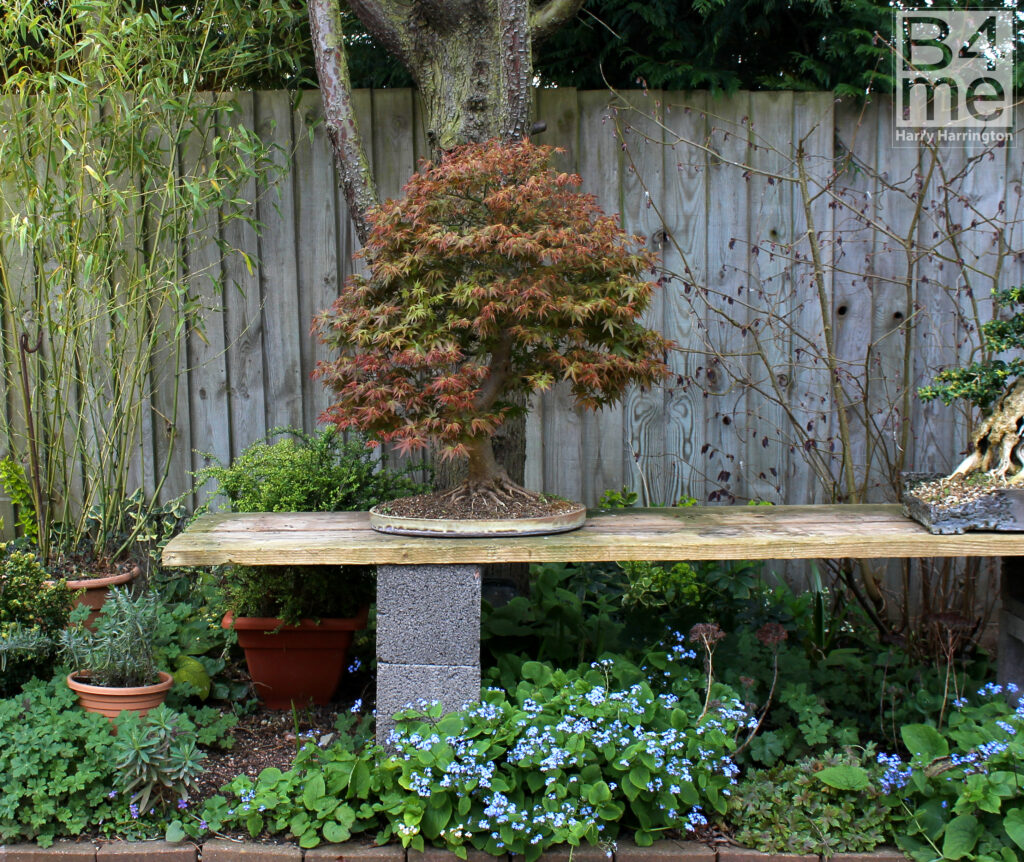
Acer palmatum/Japanese Maple bonsai in 2020 by Harry Harrington. Pot by Victor Harris.
Example Air-layer: Acer palmatum
.jpg)
This Acer palmatum branch will be used to create the air layer.
It is late May and the Spring leaves on the Parent tree have just started to harden off, so it is time to make the air-layer.
.jpg)
A strip of bark is removed just below an old leaf node. After the bark is removed, all of the green cambium layer below it is carefully scraped away; any cambium left could make the layer fail by allowing the tree to bridge the ring-bark.
.jpg)
The area is dusted with rooting hormone, wrapped with sphagnum moss and held into position with a clear plastic bag.
.jpg)
Six weeks later and the new roots have appeared in the bag. At this point, care must be taken that the sphagnum moss is kept damp.
.jpg)
Another couple of weeks are allowed to pass whilst the new roots strengthen and then the air-layer is separated from the parent tree
.jpg)
The tree is then potted up and pruned back heavily to reduce the stress on the new roots.
It is very unlikely that the new tree will put out any new top growth for the remainder of the year; instead it will produce a big flush of root growth.
The new root system will still be relatively weak for the first year and during the following Winter, extra protection should be given to the tree.
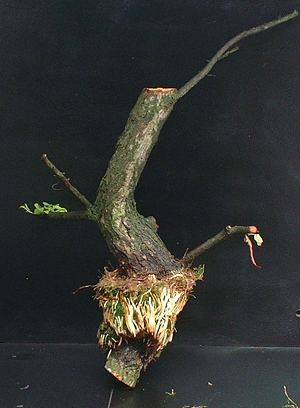
Larger airlayers can be taken from some tree species.
Above is a 5″ thick English Elm airlayer………….
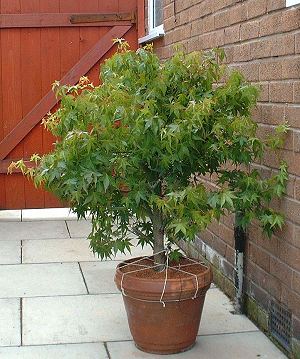
And a larger Acer palmatum airlayer.