Japanese
White Pine for a Dummy
I’ve
documented my “spur of the moment” introduction
to bonsai round about the mid to end 1990s elsewhere (Juniper
Story) and after about 6 or 7 years, I must have had
over 100 trees in various stages of development ranging
from home grown seedlings to what I considered at the time,
to be quality pre-bonsai purchased from various outlets.
(I’m down to about half this now, split between the
house and an allotment)
I was
at the stage where I was becoming increasingly frustrated
with my own efforts, probably becoming aimless and I was
impatient to get my hands on better trees to work with.
In August 2004,
after much deliberation and at least 10 trips to his stand
over an August weekend, I purchased the Japanese White Pine
pictured below from Ken Leaver of Windybanks Bonsai at the
annual Broadlands Craft Show in Hampshire.
The tree was
a Japanese import, stood around 14” high (36cm) and
was estimated to be about 12 years old. Ken Leaver helped
me select it from 3 similar trees and recommended this one
due to the well-developed trunk base, overall shape, unobtrusive
graft and good branch arrangement.

Japanese
White Pine as bought
So here I was
with my first £100 tree and not a clue what to do
with it.
I began
badgering a local Japanese White Pine owner I had met via
the Garden Web Bonsai Forum (Richard Fish) for help and
advice. Fortunately he was very patient and it was also
fortuitous that Richard was taking lessons at the time from
Nobuyuki Kajiwara – a well known sensei on the European
bonsai circuit - who as I discovered subsequently, had also
trained Ken Leaver of Windybanks Bonsai in White Pine care.
We used
to rendezvous in the car park of a local community centre
ridiculously early on Sunday mornings before the lessons
and I’d help Richard, Nobu san and the students carry
their trees inside whilst picking up what advice I could
from all and sundry for free. A bonsai groupie no less!
Acting
on advice, the first thing I did in August 2004 was prune
off the very vigorous shoots from branch ends to see what
I had and open the tree out for a good look. I also embarked
on a quite sparing watering regime – probably no more
than 3 times a week in the deep training pot and also began
using rapeseed cakes as fertilizer with a roughly bi-monthly
dose of half strength Miracid.

After
initial pruning
Following
the advice I was receiving second hand from Nobuyuki san
via Richard Fish, I started to really examine the tree in
Oct 2004 with a view to coming up with an initial pruning
and development plan. There was no doubt in my mind that
at least one of the bottom two branches would have to go.
Although these branches were very well developed (see below)
they were essentially sacrifice branches and had served
their purpose in thickening the lower trunk.

Bottom
left and right branches
Even if the tree
ended up being shorter, the bottom left branch (below) was
certainly too low to meet the convention of it being one
third of the way up the tree which was part of my understanding
of bonsai design. By this time I had also moved the tree
into a plastic pot and surrounded it with 50:50 medium akadama
and grit without disturbing the original root ball to allow
for free drainage during the very wet English winter.

With
the foliage opened out
So in
November 2004 I took the major step of removing both bottom
branches. I plugged the pruning wounds with plasticine mixed
with Vaseline. (This home made cut paste is still in place
2 years later)

With
one branch removed
With
both lower branches removed
It is perhaps
prudent to outline my understanding of the Kajiwara Method
for Japanese White Pine development at this point.
In brief terms,
he advocates no full scale candle pinching in spring or
summer and allows free vegetative growth.
Then
around November you prune off strong, unwanted new shoots
to allow the weaker shoots further back on the branch to
develop. This is the finer “Bonsai Growth” you
are trying to encourage in this methodology. The provisos
being that you don’t do heavy pruning on a branch
that you wish to lengthen and thicken or remove all the
foliage from any one branch.
You
then balance development of the tree by pulling more needles
from stronger areas and less from the weaker areas that
need to be strengthened, leaving the buds(at the base of
the needles) intact.
Initially
I found the idea of actually pulling needles off the tree
to promote new growth (via back buds) hard to grasp but
did as I was advised and pulled a few needles from the bases
of the strongest shoots that remained.
Following
this advice I pruned off all the surplus strong shoots at
the branch ends, taking care to leave weaker buds in the
interior of the branches intact. The following picture by
Richard Fish illustrates the principle showing strong shoots
that could be pruned off depending on what your intentions
are with the particular branch.

By November
2004 the tree was virtually unrecognisable and in a new
pot. It showed good taper and had about 7 or 8 main branches
in position at strategic points around the trunk that diminished
in size nicely towards the top. During what was an exceptionally
wet winter, I actually tied heavy plastic around the tree
trunk and pot as a raincoat at one stage.

November
2004
In April 2005
I started to panic and frantic emails were dispatched to
my advisors, the gist of which were,
“The tree
isn’t budding - I’ve killed it!”
I remember
placing a “Dear Abby” type post on Garden Web
seeking advice and I was advised to be patient. Sure enough
by the end of April, tiny buds began appearing that then
developed rapidly into candles by mid May 2005 (see pics
below) with the result that the tree began to fill out nicely.

New and developing buds side by side
Having successfully overcome the major hurdle of (as I thought)
using and abusing the tree for 8 months, with it then surviving
and indeed thriving, I started to look at it in more detail.
The current planting angle and branch arrangement was clearly
unsuitable as shown in the picture on the left below. It
looked much better turned almost 180 degrees as on the right.

Then in late
June 2005 after much deliberation I decided to re-pot the
tree. The tree was strong and logic indicated that a tree
in good condition should be able to take at least light
duty treatment of this sort mid-way through the growth cycle.
By June the tree looked even better to me from the new angle.

Proposed
new planting angle
This decision
to re-pot was based as much on my own impatience to do something
with the tree as it was on USA bonsai artist Vance Wood’s
writings on the benefits of summer re-potting of Mugo and
Scots pines on the Bonsai Talk Forum as well as consultation
with local bonsai outlets.
This
sort of work is possible in mid-summer as certain pines
have a semi dormant period when, in simple terms, they take
a breather to gather strength for the late summer growth
spurt in preparation for winter.
Summer re-potting
is not a thing to be undertaken lightly and I would only
recommend it if you are sure of how the species will react
and confident in your abilities. Some trees may benefit
but you may kill many others. Conventional wisdom says June
is a bit early as well, with July into August being better
in many peoples’ opinion.
The tree was
bare rooted as far I could without doing major root damage.
(below left) The original potting soil was a mixture of
yellow kanuma and akadama exhibiting a dry, fluffy beige
appearance. This was the “legendary” and beneficial
mycelium fungus that grows in amongst tree roots –
pines especially - and helps the tree to absorb nutrients
in layman’s terms. (see close up below right)
. 
The tree was re-potted in a round speckled pot using about
60% of the old soil to incorporate as much of the fluffy
fungus as I could and 40% fresh, medium akadama. The tree
was wired into the pot securely and the soil surface was
mossed for the following photograph that was posted on Garden
Web Bonsai Forum and later on Bonsai Talk Gallery.

My own comments
on the tree were,
“The pot
is too large but I have a smaller one just like it. The
tree probably needs to sit straighter and should be lower
in the pot. Rather than the rugged old pine tree image often
employed, I see a happy little tree growing on a green hill.”
Clearly I was
feeling quite pleased with myself at this stage. But at
the same time I was slightly paranoid to say the least that
I might have gone too far this time. A quote often heard
that “You’re not a true bonsai person until
you’ve killed at least one good tree,” kept
echoing in my head.
In hindsight
I had created an amorphous green triangle in a totally unsuitable
pot but at least it had a good trunk and some potentially
well placed branches. I had studied the tree, made something
of a design plan, acted on it and executed it instead of
just looking after it like the “arboriculturalist”
I had been until this time.
During 2005 I
started participating on The Bonsai Site Forums and began
discussing the tree with Harry Harrington amongst others
and took much of the advice I had been given on board. In
November when the annual “prune and pluck” phase
came around again, I re-wired the tree to try and improve
the shape by bending the first left branch down and trying
to work some movement into the very stiff looking back branch
visible at the bottom right below. From the side it stuck
out like a frying pan handle!
My needle plucking
was again very tentative as I felt the tree had been through
a lot that year.

I applied guy
wires attached to screw eyes in the trunk to pull the branches
down further in an attempt to age the appearance and tried
to arrange the foliage into pads. This wasn’t very
successful as you can see below.

During March
and April 2006 I made it my business to find out all I could
about the mysterious Japanese White Pine with a view to
really trying to crack this tree later in the year. I spoke
to vendors, bonsai teachers and searched every website I
could find for insight. I published the findings –
which weren’t particularly startling or conclusive
- in the form of a survey on Bonsai Talk Forum. Most of
the information I had found re pruning and candle pinching
of Japanese White Pines was vague and contradictory in fact,
so I resolved to stick with my original method of not doing
any general candle pinching at all.
The tree was
fertilised heavily in early April with slow release Osmocote
cones and rapeseed cakes along with the bi-monthly dose
of Miracid. It responded with a massive flush of new growth
in mid May right on schedule.
The
tree suffered a sustained sparrow attack in June which resulted
in the tree nearly being dug out of its pot and some root
damage which necessitated an emergency re-pot. I used a
matt brown oval pot I had bought as a possible final pot
for the tree. (The tree now has a permanent screen of heavy
duty drainage mesh over the soil to protect it from any
future attacks).

This last summer
(2006) was another real scorcher in the southern UK but
the tree did well with just a light watering every day sitting
in 80 deg F plus temperatures in full sunlight for 4-5 weeks
straight.
In keeping with
the development methodology outlined above, I did no general
candle pinching at all during the 2006 growing season but
did remove 2 or 3 massive shoots near the top of the tree.
I had a holiday
in early September leaving the watering to younger family
members. I moved everything to the shadier side of the garden
in the shadow of a shrub border with instructions to soak
everything with a fine hose mist every other day. I was
please to find all my trees healthy and well on my return.
During October
I removed a lot of yellowing needles that I recognised as
3 year old needles further back from the branch ends that
were dying off and that should have been plucked off last
winter.
As this year’s
time (2006) for “pruning and plucking” drew
nearer I was seeing more possibilities for the tree. I’d
benefited from intense Bonsai forum activity, personal research
and also an all day visit with Harry Harrington during August
where we discussed, inter alia, wiring, and creating the
illusion of foliage and branching on shohin trees.
The oval pot
and the angle at which the emergency re-pot had been done
were clearly not showing off the tree to its best advantage.
After 2 years I had also started to get some back budding
on older wood with new shoots that needed to be exposed
to light and air in order to develop.

In November 2006
I completely unwired the tree and removed all the guy wires.
I pruned off a few over-long branch ends and the tufty topknot
of an apex. For the first time I really did some serious
needle pulling on the strongest shoots near the top of the
tree and the ends of the strongest major branches.
After I did the
best wiring job I’ve ever done on virtually every
shoot, a few turns on the turntable and a bit of propping
up made it apparent the tree would look better sitting up
straighter and rotated slightly as shown in the pictures
below.

I had found out
via Harry Harrington on the Bonsai Site Forum that the Bonsai
Today Masters series book on Pines was available in the
UK so I ordered it up from Kaizen Bonsai and began to read
avidly. The photographs showing the needle pulling operation
were particularly enlightening.
This gave me
the additional confidence I needed to do even more needle
pulling. I refined the wiring a little more to tidy up a
few stray shoots and slipped it into another pot that I
purchased with this tree in mind earlier in the year and
took the photo below.

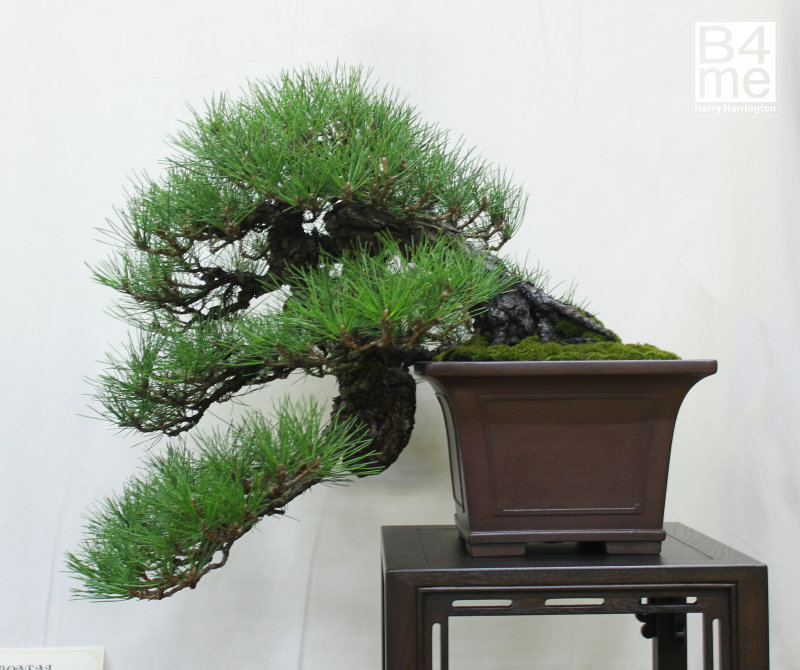
Although this
is by no means the “finished article” it is
certainly becoming more like a Japanese White Pine bonsai
although barely a foot high (30cm) from the pot rim.(shohin
size)
The more extensive
needle plucking has opened the tree out and we can just
start to see the beginnings of a visible branch structure
rather than a jumble of needles.
The more rounded
top has matured the tree somewhat and the initial trunk
angle from the pot with the subsequent movement to the right,
forward slightly and then up does give some immediate visual
interest I feel. The “frying pan handle” rear
branch is now more under control and gives the tree some
visual depth even in the photo.
The pot is about
the correct depth. Something a bit plainer in style, slightly
narrower, a tad more shallow and nearer to the trunk colour
will probably be better eventually.
I added a line
of moss along the front edge of the pot for the photo. There’s
not tremendous nebari down there but there’s no faults
either and maybe it should be shown off.
There
is still too much foliage on the tree giving it very cuddly
feel and the needles are comparatively large for such a
small specimen. The foliage needs to more sparse and impressionistic
and I’ll need to learn how to achieve that.
Walter
Pall has a well known 100 year old Pinus Sylvestris ( Scots
Pine) very much in the style I would like to aspire to .
(see below)

Scots
Pine by Walter Pall
In
keeping with my “one season at a time” approach,
I will wait until next November before really tackling this
tree again. By then I may really have the confidence to
reduce the needles down to 5 or 6 pairs on each shoot and
see what happens.
T Riley
Dec 2006
Thanks
to Harry Harrington, Vance Wood and Walter Pall for their
assistance.
Appendix
Japanese White
Pine
Suggested Personal
Care Guide – for UK Zone 7-9
Please
note that this care plan is aimed at trees in development
– not show-ready bonsai.
| Soil |
Initial
mix was 60 % old soil and 40% medium akadama. I am now
using Tesco Premium
Lightweight Cat Litter (Kittydama) which is super
hard clay balls along with Akadama in a 40% Akadama
40% Kittydama 20% old soil mix by volume. I have added
a small handful of composted bark (soil conditioner)
on occasion but am omitting this now. |
| Watering |
Water thoroughly with a light spray when the tree needs
it and check it every day between April and October.
I use a small, very fine rose watering can and often
water daily in high summer but not if there has been
recent rain. In the usually very wet UK winter I don’t
water at all between November and March probably and
sometimes protect the tree with a plastic cover in times
of extreme rain. |
| Fertilizer |
2
rapeseed cakes per 9 x 6 inch (22.5 x 15cm pot) starting
in March changing them every month to 6 weeks. Add 2–3
slow release general-purpose cones in the pot corners
– I’m using Osmocote. Miracid every other
month at half strength. An inert soil mix based on Akadama,
hard fired cat litter and/or grit will need regular
fertilizer. |
| Pruning |
Hard
prune in November to remove unwanted branches and over-
strong or unwanted shoots. Think carefully before you
remove anything and have an end design in mind. What
is an out of place shoot now - may become a branch of
the future or can be wired into position. (see diagram
below) |
| |
|
| Candle
pinching |
No
full-scale candle pinching in spring or summer. Remove
wildly out of place and downward pointing candles if
you can’t resist. Spring and summer candle pinching
becomes more important for developed trees to maintain
shape. |
| Needle
Pulling |
Pull out bundles of needles on strong shoots near the
top of the tree and at branch ends to leave at least
5 or 6 bundles minimum on the strongest shoots. These
can also be cut off with sharp nail scissors leaving
about 2mm of needle as a stub. Leave more needles on
weaker shoots further back on the branch. (see diagram)
|
| |
|
| Bud
Pruning |
After
pruning and needle pulling aim to leave 2 buds in each
position. Leave 2 weak buds on strong branch shoots
and 2 strong buds on weak branch shoots Protect anything
that looks like a bud further back on the branches. |
| Wiring |
I
do my major wiring in winter taking care not to dislodge
or damage latent or new buds where possible. Do your
wiring after needle plucking to get a clear picture |