I found
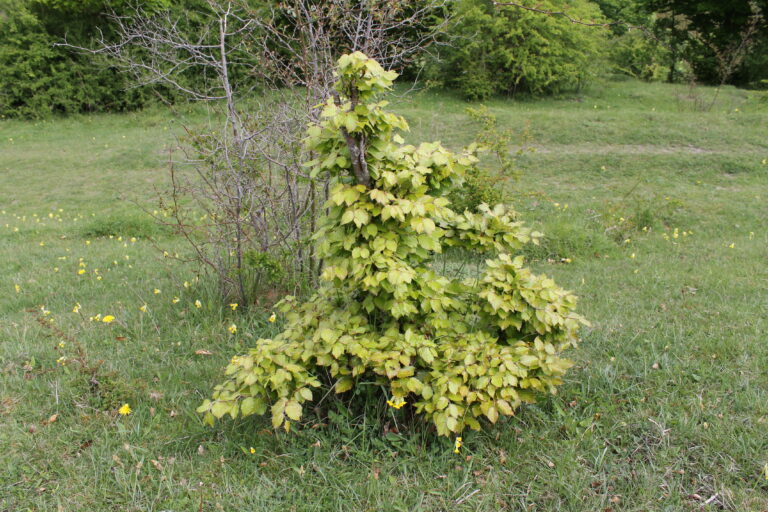
this Hawthorn (Crataegus monogyna) in the late Summer of 2002
while out walking and hunting potential material to collect
during the following Winter and Spring.
When trying
to find suitable material for bonsai in the wild, it can be
difficult to decide exactly which features mean that a tree
has or hasn't potential for bonsai.
Most importantly,
on all deciduous trees, the trunk must be considered above
all else.When looking for potential deciduous trees to collect,
look for good trunks. Look for those that have good movement
and are not too straight (often a problem with wild Hawthorn),
have mature bark and sufficient trunk girth.
Often
(but not always), the branches that exist
on the tree in the wild will need to be regrown as they are
often too heavy or badly positioned for the final bonsai design.There
is also possibility that on a large mature field growing tree
there will be no low branches at all.
A common
mistake made by those new to collecting is to take home trees
that have fantastic branch structure ramification without
consideration of the trunk or whether the branch structure
is low enough on the trunk to actually be usable for bonsai.
(I would also note
here that a problem particular to Hawthorn is that any remaining
low growth frequently consists of flowering branches and spurs
that will not produce new flushes of vegetative growth necessary
for the construction of new branches in the future.)
Finally,
consideration must be given to the likely-hood that the tree
can be collected and successfully nurtured back to health.
Trees that are already weak in the ground will not react well
to the stress of collection. Hawthorn (and many other deciduous
trees) will grow very thick long tap roots with little of
the fine feeder roots required for survival when found growing
in dry, open soils. This makes them much more difficult (and
sometimes impossible) to collect successfully. On the other
hand, trees (such as the one above) found growing in soils
that remain wet, moist or boggy even during the growing season
will have much denser, more compact rootballs and are considerably
easier to collect successfully.

Having
marked the tree as having potential for collection, I left
it alone until late Autumn of 2002. When the leaves had dropped
and the bulk of the tree's energy was safely stored in the
root system and trunk, it was time to chop it back hard to
what I considered to be the future trunkline. The tree is
pictured a couple of months after chopping in January 2003.
I
waited until plenty of new buds had appeared all over the
trunk in the Spring before digging a trench approximately
2 ft around the tree. This is the equivalent of a rough root-prune
and cuts through the the largest and thickest of the roots.
During the course of 2003 the tree would respond by healing
the severed roots and producing a much denser rootball consisting
of more compact fine feeder roots; all of which results in
less stress for the tree and easier collecting for me when
I finally dig up the tree and take it home.

By
July 2003 the tree has responded very well, producing many
new shoots that will eventually become part of the branch
structure. During the year I took the opportunity to feed
the tree with slow-release granules a couple of times to strengthen
the tree and promote more vigorous growth.

In
Autumn 2003 after the final leaves had fallen from the tree
, I pruned it back heavily again, leaving only growth that
I felt was suitable for the development of the tree as a bonsai.
At
this stage I seriously considered chopping the trunk down
to the the lower thick 'branch' to create a shorter tree with
greater taper. However, I felt that the tree had more character
and looked more natural at its current height and decided
to forget any ideas I might have of shortening the overall
height of the tree or removing the lower thick branch/trunk.
In
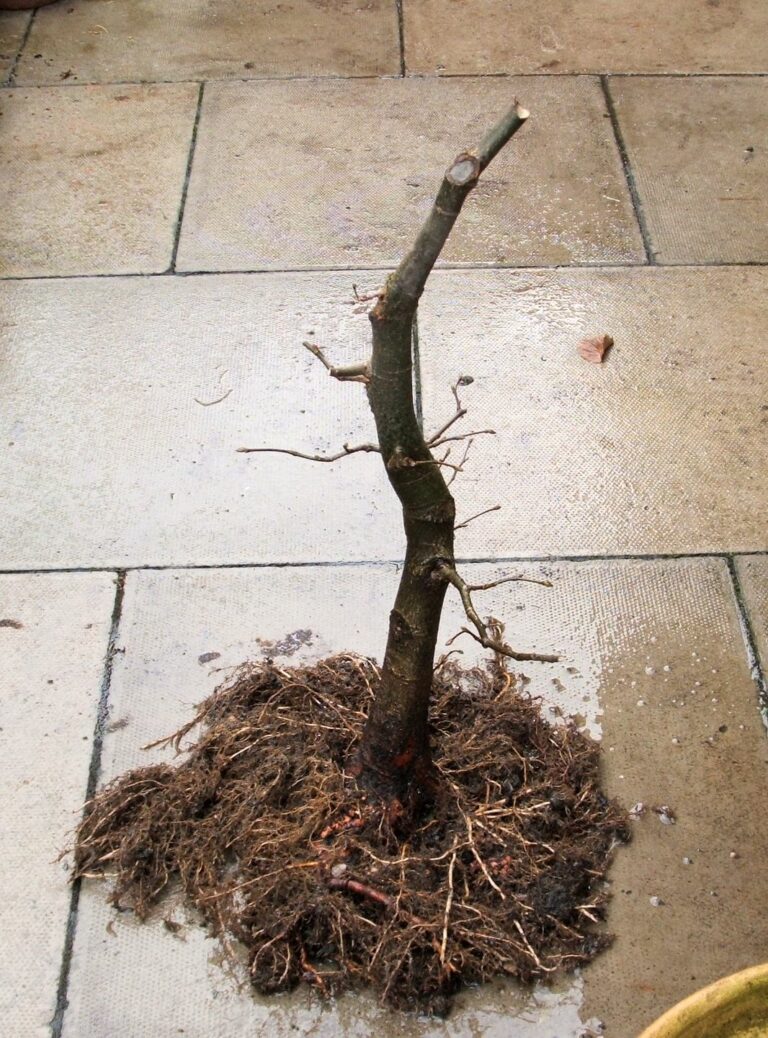
January 2004, I finally dug up the tree, collecting as many
of the roots as possible before bringing it home and planting
it up into a large terracotta bulb pan.
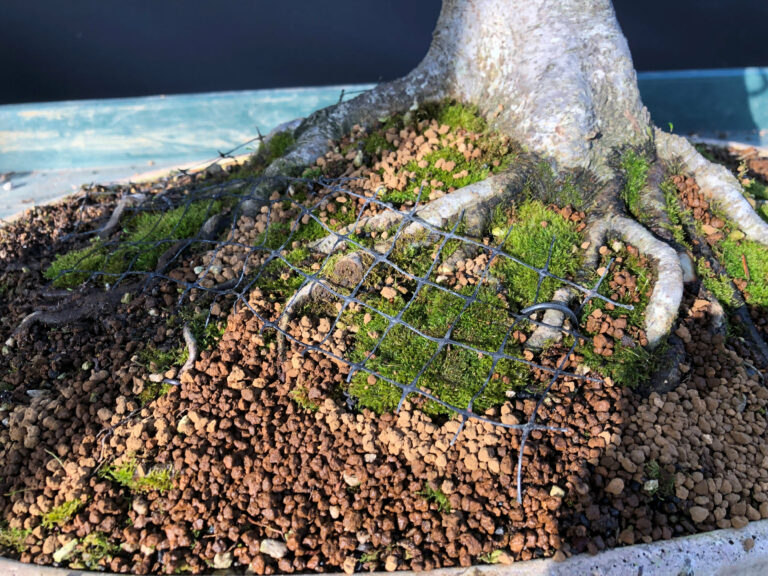
I
was very pleased to discover that underneath the surface roots
that I found while the tree was in the ground, was some considerable
trunk flare and an even better nebari (surface-roots). The
scars where the top surface roots were removed can still be
seen in the image above.
The
tree was placed in a shady frost-free position with a little
bottom heat (provided by a soil warming cable).
During
2004 the tree was very slow to bud and leaf out; not unusual
for a newly collected tree. However, by midsummer it launched
into growth and produced many new buds and shoots. It was
now time to allow the tree to grow strongly and start developing
the branch structure.

December
2006: Nearly 3 years after collection and the tree is looking
like a bonsai. A combination of twice yearly pruning and wiring
(at midsummer after the spring flush of new shoots and in
late Autumn after the leaves have fallen) has seen the branch
structure develop well.

Early
March 2007: The tree is finally planted into a pot commissioned
from Erin Pottery. My target for this tree in the next few
years will be to continue to develop the branch structure;
thickening the lower branches and increasing their ramification.

November
2007:

April
2008
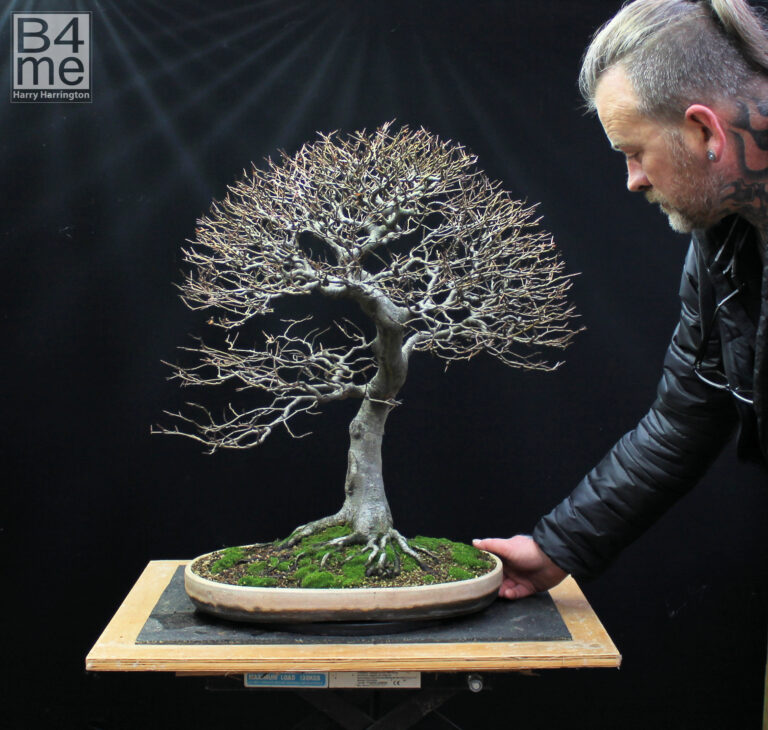
Current
height of tree: 27"/67cm, trunk diameter (above the base)
3.5"/8.5cm