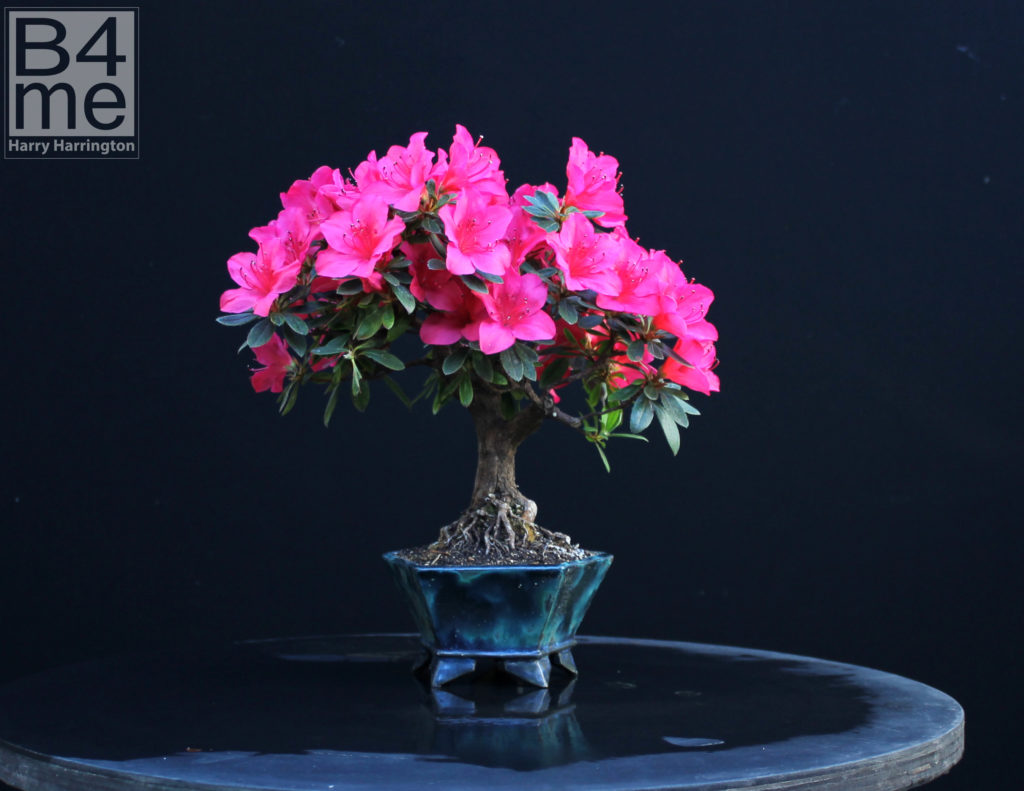
The following calendar was produced to act as a general fact sheet and month by month guide for the keeping and growing of Satsuki Azalea, primarily as bonsai but also as patio /potted plants. For a more thorough and definitive guide to Satsuki we would recommend reading “Floral Treasures of Japan” by Alexander Kennedy. Please remember that although these plants can be brought indoors for short periods at flowering time they are outdoor varieties Satsuki Azaleas have been bred and selected for over 300 years in Japan and are highly prized for their prolific and often varied flower colours. Although single coloured varieties of Satsuki are available the multi-coloured’s are often the most interesting and therefore, most popular. With their small, glossy green leaves, their quick growth and ability to withstand pruning/shaping these plants are ideal candidates for bonsai styling. For 11 months a year, they can be seen as perfectly formed bonsai but then for that one special month a year they erupt in a profusion of colour that makes this species stand out from all other bonsai.
There is a multitude of flower types and colours available on the thousands of Satsuki varieties available, the main four being: Selfs-single colour, Fukurin-coloured centres with white edges, Sokojiro-white centre with coloured edges and Shibori-which covers all the stripped, half & half, flecked and combinations of all these. Of the varieties available in the UK Kaho and Gyoten are probably the most common. Kaho will be recognizable by its mainly white flowers but also with pink, self’s & pink/white stripes. Gyoten (a sport of Kaho) has mainly pink flowers with frilly edges.
The word Satsuki consists of two Japanese kanji characters; “Sa”, which is an old term for five, and “Tsuki”, which is the word for moon. Satsuki therefore means fifth moon, in other words the fifth moon of the oriental lunar calendar. This is equivalent to around June in our calendar and refers to the flowering period, as Satsuki flower around late May or early June. There has been a lot of discussion and debate regarding the origins of Satsuki azaleas but they are primarily derived from just two species, Rhododendron indicum, the “river satsuki”, and Rhododendron tamurae (syn. Eriocarpum), known as the “round leaved satsuki”.
Some modern botanists have suggested that other species must have been involved because crossing wild plants of these two species does not give rise to all Satsuki characteristics. Other experts oppose this view, pointing out that plants found today in the wild do not reflect the original, very diverse plant population, because plant hunters or amateur gardeners have long since collected all unusual and interesting wild specimens.
JANUARY & FEBRUARY These are quiet months for Satsuki Azaleas, being virtually dormant at this time of year. Older, larger trees can withstand a degree or two of frost, but younger plants must be protected. A cold greenhouse is ideal but if you do not have this facility try to position trees somewhere where they receive some protection from the worst of the wind and rain, maybe under the staging or at the base of a hedge. In either case be prepared to provide additional frost protection in the form of bubble wrap or insulating fleece during cold spells. Cold is not the main threat to Satsuki in winter -Water logging is, hence the need to keep trees under cover. In a greenhouse, leave the door and roof vents open on all but the coldest days to allow free air movement in the house. This will reduce the risk of mildew and other fungal diseases occurring and will also prevent temperature build up during any sunny days we might have. Trees will require water through the winter period but be careful not to over-water at this time. The ideal watering regime, as with all bonsai whatever the species, is to check each plants needs individually.
Many factors determine a tree’s uptake of water. Satsuki, like other forms of Azalea are members of the Ericaceae family and as such are Lime haters. If you live in a hard water area use collected rain water if possible. Last seasons leaves will have fallen by now. If your trees are protected from wind these will accumulate on the soil surface and rot. Remove all fallen leaves, and the yellowing ones still attached to the tree. You may well be able to see the signs of growth appearing around the base of flower buds. These will produce this years shoots and on a healthy plant, there could be anything up to five around each bud.
MARCH Plants over-wintered under cover will start showing signs of growth this month. New shoots will be seen emerging mainly from around the base of the flower buds but depending on the vigour of the tree shoots could be found anywhere on the trunk and branches! Trees can be brought out from cover on mild, sunny days but do not be tempted to leave out overnight as a frost could damage new shoots. There are two periods per growing season for re-potting Satsuki, one just after flowering in late May/early June or now in late March. If growing-on young, untrained material, now is ideal as it will allow a full season, unchecked growth. If it were rapid, growth you are after it would be beneficial to remove all, if any flower buds. Feeding should also begin this month on young and older trees alike. Specimen plants should be fed regularly from now until bud burst to help strengthen them prior to flowering. March is also a good time of year for refinement wiring of young growth in foliage pads. Heavy wiring to shape trunks and branches is best left until the autumn. ‘Kanuma’, a form of Japanese soil is often said to be the ideal potting medium for Satsuki Azaleas. The will however grow in any lime free compost mix.
APRIL This is the month when Satsuki’s really begin to wake up after the winter’s rest, particularly if they have been over-wintered under cover. Main areas of growth are as mentioned above but also “sucker” like growths are commonly seen growing from roots at or just below the soil surface. Unwanted growth can easily be rubbed off but before you do have a good look at the design of the tree first to assess if any of these shoots might be in just the right place to develop into new branches. On strong growing varieties of Satsuki up to five or more shoots will grow from around the base of flower buds so to stop the flowers being swamped by foliage later in the year it is best to thin these out to two, preferably horizontal shoots either side of the bud. Continue feeding throughout this month using fertilizers specially formulated for ericaceous plants. As an alternative, there is an excellent fertilizer from Japan called “Biogold.” This comes as small cubes that you press into the surface of the soil. Unfortunately, this is only available from Bonsai Nurseries. Trees still under cover can be brought out now but be careful of sudden frosts. They are unlikely to kill a tree but they can damage flower buds.
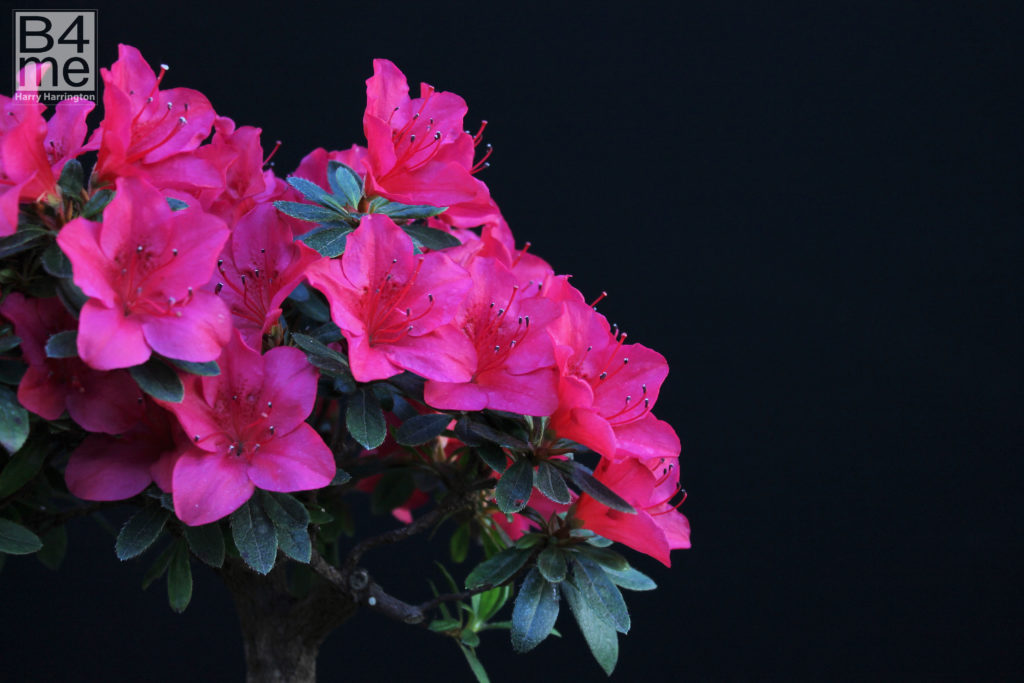
MAY Flower buds will be swelling nicely now, in fact some will be showing colour or even be open depending on weather conditions and how the plant has been over wintered. Strong growing shoots from the base of the buds should be trimmed back to allow the flowers space to open. Because of the prolific number of flowers, a tree can produce, to reduce stress it is good practice to reduce the number by anything between 30 – 50%. On a show tree, this can be achieved by removing most of the flowers from the back. On young plants, being grown on it would be advisable to remove all the flowers to encourage maximum growth. Stop feeding now. This will encourage a longer flowering period. Providing some kind of temporary shelter to protect the buds and flowers from rain will stop them from discolouring. For the same reason, be extra careful when watering. This temporary shelter will also serve as a sunshade to help stop flowers fading prematurely. This is a busy time in the growth pattern of Satsuki and demand for water will increase
accordingly.
JUNE Remove all flower heads. Although this can be a tedious, time consuming job it is important to prevent the production of seed, which puts undue stress on a tree at a time when it needs to recover from the rigours of flowering. New growth slows for a short period after flowering and this is an ideal time for repotting, wiring and pruning/trimming to shape. (See Pruning Azalea Bonsai) Feeding can re –commence once flowering has finished but wait a few weeks if trees have been repotted. Likewise, care should be taken not to over water newly repotted trees. As mentioned previously, Satsuki, like all other azaleas and rhododendrons, produce a profusion of new shoots from the base of old flower buds. With Satsuki, it is best to remove all unwanted shoots leaving just two, one either side of the bud. These are then trimmed back to two pairs of leaves.
JULY Some late flowering varieties will still be in flower this month. Allowing trees to flower this late in the year can have a long-term detrimental effect on the plants health. Hard as it seems, all flower buds/flowers should be removed, especially if the tree is about to be repotted. Leaving flowers on this late will weaken the tree at a time when it should be producing next year’s flower buds. A short time after flowering is over a second spurt of growth occurs. Satsuki are relatively pest free but keep a watch out for greenfly, red spider mite and vine weevil. Satsuki’s will tolerate or even appreciate a position in full sun but will tolerate semi-shade.
AUGUST All repotting and pruning should be finished by now. From now on Satsuki’s should be allowed to build up strength for the winter and it is also during this period that next years flower buds are produced. Continue regular feeding and watering. This year’s shoots will still be extending but slowing down now. These shoots will carry next year’s flowers. Any shoots that were trimmed earlier in the season might well be showing secondary shoots growing from them. If these are strong enough they will also produce flower buds. Some light trimming and removal of unwanted growth can still be carried out but remember that trimming at this time of year will mean removing flower buds.
SEPTEMBER Pretty much as per August. Growth will be slowing right down now; subsequently watering needs will be less however continue feeding.
OCTOBER As previously described, Satsuki have two distinct growth periods, one in the spring prior to flowering and again after flowering. The leaves produced in the first flush of growth will start changing colour this month and eventually fall. Unfortunately there is no spectacular autumn colour display like many other Bonsai subjects, just a change from Green to Yellow although I have seen the leaves of red varieties turn to a shade of red like a maple, but this only happens occasionally.
The second flush of growth in the summer, mainly clustered around the flower buds, will remain on throughout the winter. Remove all leaf litter from the surface of the compost.
NOVEMBER & DECEMBER. Generally as October. Late October/early November is the time of year to start preparing winter quarters for trees. A cold greenhouse is ideal but any cover that will offer some protection from heavy frosts and in particular, constant, heavy rain will do. Remember that Satsuki’s are not deciduous so a dark shed or garage will not do! During the winter try to provide as much ventilation and light as possible to avoid mildew.
Water as required -do not over water.
Remember that you will need to compensate for the above timings by up to a month depending on where you live in the country. These timings are based on the UK, therefore the northern hemisphere in terms of seasons.